
Australia Biochar Market Projected to Reach USD 169.3 Million by 2034
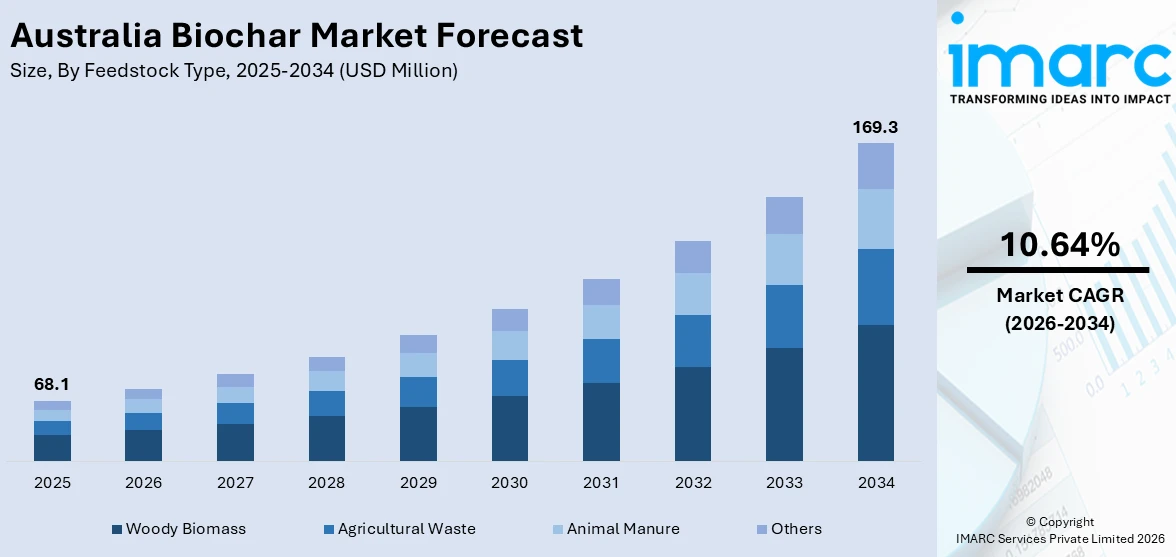
Australia biochar market size reached USD 68.1 Million in 2025. Looking forward, the market is projected to reach USD 169.3 Million by 2034, exhibiting a growth rate (CAGR) of 10.64% during 2026-2034.
Australia Biochar Market Overview
The Australia biochar market encompasses the production, distribution, and application of carbon-rich materials derived from the thermochemical conversion of organic biomass through pyrolysis, gasification, and hydrothermal carbonization processes. Biochar is a highly stable, porous carbonaceous material produced by heating woody biomass, agricultural waste, animal manure, and other organic feedstocks in oxygen-limited environments, resulting in a product that serves as a powerful soil amendment, carbon sequestration medium, water filtration agent, and livestock feed additive. As Australia intensifies its commitment to achieving net-zero emissions, regenerative agriculture, and circular economy practices, biochar has emerged as a uniquely versatile solution that simultaneously addresses soil degradation, carbon capture, and organic waste management challenges across the agricultural, environmental, and industrial sectors.
The Australia biochar market size reached USD 68.1 Million in 2025. Looking forward, the market is projected to reach USD 169.3 Million by 2034, exhibiting a growth rate (CAGR) of 10.64% during 2026-2034. The market is being driven by increasing demand for sustainable agriculture practices, government carbon credit incentives and carbon farming programs, growing adoption in carbon sequestration and waste-to-energy projects, advancements in pyrolysis technology that improve production efficiency and scalability, climate change mitigation efforts under international commitments, and the expanding application of biochar in water treatment, soil remediation, and industrial composites.
Australia’s agricultural sector is increasingly embracing biochar as a transformative soil amendment that enhances fertility, water retention, and microbial activity while sequestering carbon in soil for centuries. With the country’s sustainable agriculture market valued at USD 7.47 billion in 2024 and projected to grow at a CAGR of 13.70%, the convergence of regenerative farming practices, government-backed carbon credit programs, and growing awareness of soil degradation is creating a powerful demand foundation for biochar products. The rising value of biochar carbon credits, which averaged USD 164 per tonne in 2025 representing a 25% increase since 2023, further underscores the economic viability and climate mitigation potential that is attracting investment from both agricultural enterprises and environmental technology companies across Australia.
How AI is Reshaping the Future of the Australia Biochar Market
Artificial intelligence is unlocking transformative new capabilities across the biochar value chain, from feedstock optimization and production process control to carbon credit verification and precision soil application, fundamentally enhancing the efficiency, scalability, and environmental impact of biochar solutions in Australia:
• AI-Optimized Pyrolysis and Production Process Control: AI-powered automation is transforming pyrolysis technology by enabling real-time monitoring and control of temperature profiles, residence times, and atmospheric conditions during biochar production. Machine learning algorithms analyze sensor data from production systems to continuously optimize process parameters, ensuring consistent biochar quality, maximizing carbon retention efficiency, and minimizing energy consumption. These intelligent systems can predict optimal production settings for different feedstock compositions, automatically adjusting processes to maintain target specifications for porosity, carbon content, and nutrient retention across varying input materials.• Intelligent Feedstock Selection and Supply Chain Optimization: AI platforms are revolutionizing feedstock management by analyzing data on biomass availability, seasonal supply patterns, chemical composition, moisture content, and transportation logistics to optimize raw material sourcing strategies. These systems predict feedstock quality variations across different regional sources and agricultural seasons, enabling producers to develop blending formulations that ensure consistent biochar output quality despite inherent variability in organic waste streams. AI-driven supply chain intelligence also identifies cost-effective sourcing opportunities and minimizes procurement risks associated with seasonal and regional supply fluctuations.• AI-Enhanced Carbon Credit Verification and MRV Systems: Measurement, reporting, and verification (MRV) systems powered by artificial intelligence are strengthening the integrity and efficiency of biochar carbon credit programs by automating the quantification of carbon sequestration, tracking biochar stability over time, and verifying permanence claims with scientific rigor. These AI-driven platforms analyze production data, soil application records, and environmental monitoring inputs to generate transparent, auditable carbon removal certificates that meet international standards, reducing verification costs and accelerating credit issuance timelines for Australian biochar producers participating in voluntary and compliance carbon markets.• Precision Agriculture and Smart Biochar Application: AI-integrated precision agriculture platforms are optimizing biochar application strategies by analyzing soil composition data, crop requirements, climate conditions, and historical yield patterns to determine ideal application rates, timing, and placement for maximum agronomic benefit. These systems leverage satellite imagery, IoT soil sensors, and machine learning models to create variable-rate application maps that customize biochar deployment across different field zones, ensuring that each area receives precisely the amount needed to maximize water retention, nutrient availability, and microbial activity for specific crop types and soil conditions.• AI-Driven Biochar Property Prediction and Custom Formulation: Machine learning models are enabling manufacturers to predict biochar properties including surface area, cation exchange capacity, pH levels, and heavy metal adsorption capacity based on feedstock characteristics and processing parameters, without requiring extensive laboratory testing. These predictive capabilities allow producers to develop customized biochar formulations tailored to specific applications, whether for acidic soil remediation in Queensland’s sugarcane regions, water filtration systems in mining operations, or premium horticultural products for viticulture, dramatically reducing product development cycles and ensuring application-specific performance optimization.
Request a Business Sample Report for Procurement & Investment Evaluation:
https://www.imarcgroup.com/australia-biochar-market/requestsample
Australia Biochar Market Trends
Carbon Sequestration and Carbon Credit Market Expansion
Biochar’s exceptional capacity to lock carbon in soil for centuries is positioning it as one of the most credible and scalable carbon dioxide removal technologies in Australia’s climate mitigation toolkit. The biochar carbon credit market has experienced substantial growth, with average credit prices reaching USD 164 per tonne in 2025, a 25% increase from 2023 levels, reflecting growing confidence in biochar’s permanence and verification methodologies among corporate buyers and institutional investors. Australia’s carbon farming framework and emissions reduction fund are providing structured pathways for biochar producers to monetize carbon sequestration, creating additional revenue streams that improve the economic viability of biochar production and incentivize investment in new production capacity. The convergence of tightening corporate emissions disclosure requirements, growing voluntary carbon market demand, and Australia’s international climate commitments is accelerating the integration of biochar into national carbon reduction strategies.
Waste-to-Energy Integration and Circular Economy Models
The integration of biochar production with waste management and bioenergy systems is emerging as a transformative trend that aligns with Australia’s circular economy objectives. Pyrolysis-based biochar production simultaneously generates clean syngas and biochar from agricultural residues, forestry waste, and municipal organic waste, creating a dual-output model that converts waste streams into valuable products while reducing landfill volumes and greenhouse gas emissions. The Australian Government’s commitment of USD 10.4 million in February 2025 to projects converting sugarcane waste into fuel, including USD 8 million for Licella’s proposed biorefinery in Queensland expected to produce 60 million litres of low-carbon fuel annually, exemplifies the growing public investment in waste-to-energy biochar infrastructure. These circular economy models are particularly attractive for regional and rural communities where abundant agricultural waste provides feedstock for biochar production that supports local soil improvement, energy generation, and carbon credit revenue.
Australia Biochar Market Summary
• Market Size (2025): USD 68.1 Million• Market Forecast (2034): USD 169.3 Million• Market Growth Rate (CAGR 2026-2034): 10.64%• Base Year: 2025• Forecast Period: 2026-2034
Australia Biochar Market Growth Drivers
Sustainable Agriculture Adoption and Soil Health Imperative
The escalating demand for sustainable agricultural practices across Australia is serving as the primary growth driver for the biochar market, as farmers and agribusinesses increasingly recognize biochar’s exceptional capacity to enhance soil fertility, improve water retention, boost microbial activity, and reduce dependency on chemical fertilizers. With Australia’s sustainable agriculture market valued at USD 7.47 billion in 2024 and projected to reach USD 25.08 billion by 2033 at a CAGR of 13.70%, the structural shift toward regenerative farming methods is creating a substantial and rapidly expanding addressable market for biochar products. Biochar’s demonstrated ability to improve crop yields in Australia’s challenging arid and semi-arid regions by enhancing drought resilience and reducing irrigation requirements makes it particularly valuable for the country’s climate-vulnerable agricultural sector. Government initiatives promoting regenerative farming, organic certification programs, and carbon farming frameworks are further accelerating adoption across both large-scale commercial operations and smallholder organic farms.
Government Carbon Credit Incentives and Climate Policy Support
Australia’s evolving climate policy framework, including carbon farming initiatives, emissions reduction fund mechanisms, and international climate commitments, is creating powerful financial incentives that enhance the economic viability of biochar production and application. Government grants, subsidies, and carbon credit programs reduce financial barriers for both producers and end-users, making biochar economically competitive with conventional soil amendments while providing additional revenue through carbon sequestration monetization. The Australian Government’s broader commitment of USD 33.5 million to decarbonize the aviation sector using sustainable waste-to-energy technologies, including specific biochar and bioenergy projects, demonstrates the growing policy-level recognition of biochar’s role in national emissions reduction strategies. These supportive policy frameworks are fostering collaboration between government agencies, research institutions, and private enterprises, accelerating technological advancements and expanding biochar’s market reach across agricultural, environmental, and industrial applications.
Australia Biochar Market Segments
The market has been comprehensively segmented by IMARC Group across multiple dimensions to provide granular insights into growth opportunities and competitive dynamics:
Breakup by Feedstock Type:
• Woody Biomass• Agricultural Waste• Animal Manure• Others
Breakup by Technology Type:
• Slow Pyrolysis• Fast Pyrolysis• Gasification• Hydrothermal Carbonization• Others
Breakup by Product Form:
• Coarse and Fine Chips• Fine Powder• Pellets, Granules and Prills• Liquid Suspension
Breakup by Application:
• Farming• Gardening• Livestock Feed• Soil, Water and Air Treatment• Others
Breakup by Region:
• Australian Capital Territory & New South Wales• Victoria & Tasmania• Queensland• Northern Territory & Southern Australia• Western Australia
Australia Biochar Market Competitive Landscape
The competitive landscape of the Australia biochar market is characterized by a dynamic ecosystem of established biochar producers, emerging technology-driven startups, agricultural input companies, and waste management enterprises competing across production technology, product quality, carbon credit certification, and application expertise. Key market participants including Rainbow Bee Eater (RBE), Biocare, Earth Systems, Pacific Pyrolysis, and CharTech Solutions are establishing competitive positions through proprietary pyrolysis technologies, strategic partnerships, and diversified product portfolios targeting agricultural, environmental, and industrial applications. The competitive environment is further shaped by collaborative ventures between technology providers and agricultural enterprises, as exemplified by the Optimal Group-Rainbow Bee Eater partnership for the ECHO2 biochar and renewable gas system capable of treating 50 million tonnes of biomass per year. Academic and research institutions including CSIRO and multiple Australian universities are contributing to competitive dynamics through biochar innovation programs that generate intellectual property and spin-off commercial enterprises.
Australia Biochar Market Latest News & Development
Recent developments in the Australia biochar market reflect the industry’s accelerating growth through strategic partnerships, government investment, and technological innovation:
• February 2025: The Australian Government committed USD 10.4 million to projects converting sugarcane waste into fuel, including USD 8 million for Licella’s proposed biorefinery in Queensland expected to produce 60 million litres of low-carbon fuel annually and USD 2.4 million for Viva Energy’s sustainable aviation fuel infrastructure at Brisbane Airport, as part of a broader USD 33.5 million national push to decarbonize the aviation sector.• January 2026: Several Australian startups introduced AI-powered pyrolysis systems designed to improve biochar production efficiency and scalability, leveraging machine learning algorithms for real-time process optimization, quality control, and carbon retention maximization across diverse feedstock inputs.• May 2024: Optimal Group entered into an exclusive partnership with Rainbow Bee Eater (RBE) to become the sole Australian and New Zealand sales and engineering partner of the ECHO2 biochar and renewable gas system. The pioneering pyrolysis technology converts organic waste into clean syngas and biochar, capable of treating 50 million tonnes of biomass per year and potentially reducing Australia’s greenhouse gas emissions by up to 10%.• March 2024: Migreen signed a Memorandum of Understanding with Biocare, an Australian biochar leader, to use advanced technologies to support sustainable agriculture and global net-zero ambitions by offering carbon removal via biochar. The partnership focuses on converting agricultural waste into biochar, enhancing soil health, and reducing emissions at large farming scales.• 2024: Australian biochar producers expanded participation in international voluntary carbon markets, with biochar carbon credits averaging USD 164 per tonne in 2025, representing a 25% increase since 2023 and reflecting growing buyer confidence in biochar’s permanence and verification methodologies as a credible carbon dioxide removal pathway.
Note: If you require any specific information not currently covered within the scope of the report, IMARC Group will provide it as part of customization.
Speak to an analyst:
https://www.imarcgroup.com/request?type=report&id=32355&flag=C
𝗔𝗯𝗼𝘂𝘁 𝗨𝘀
IMARC Group is a global management consulting firm that helps companies in strategy, operations, technology, and mergers & acquisitions. We have served over 5,000 clients across 50+ countries. Our offerings include market studies, benchmarking, company research, competitive intelligence, patent analytics, perception studies, and market sizing. We are especially known for our deep market entry advisory services.
𝗖𝗼𝗻𝘁𝗮𝗰𝘁 𝗨𝘀
IMARC Group
134 N 4th St. Brooklyn, NY 11249, USA
Email: sales@imarcgroup.com
Tel No: (D) +91 120 433 0800
United States: +1-631-791-1145