Wellness Tourism Market: Adventure and Wellness Hand in Hand
The global wellness tourism market was valued at USD 814.6 billion in 2022 and is expected to reach USD 2100 billion by 2030.
The global wellness tourism market was valued at USD 814.6 billion in 2022 and is expected to reach USD 2100 billion by 2030, growing at a CAGR of 12.42% from 2023 to 2030. Wellness tourism encompasses travel activities aimed at enhancing an individual’s physical, mental, and spiritual well-being.
Tourists participate in activities such as yoga, meditation, Pilates, spa treatments, and visits to hot spring resorts to promote holistic health. Engaging with local cultures and communities at destinations also contributes to personal well-being and enriches the overall travel experience. Unlike medical tourism, which focuses on treatment for diagnosed conditions, wellness tourism emphasizes preventive care, encouraging a healthy lifestyle and improving quality of life. The growing number of global tourists has increased demand for wellness services, prompting service providers to offer a range of therapies and wellness-focused experiences. Furthermore, rising expenditure in the tourism sector is expected to positively influence market growth.
The COVID-19 pandemic significantly impacted the market due to international travel restrictions, stay-at-home orders, and business closures. Many countries closed borders and suspended flights, causing a sharp decline in tourist numbers. According to the Global Wellness Institute (GWI), wellness trips fell by 35.8% in 2020, totaling 600.8 million globally. Economic shutdowns led to business closures, job losses, reduced purchasing power, and increased travel hesitancy due to fear of infection.
Order a free sample PDF of the Wellness Tourism Market Intelligence Study, published by Grand View Research.
Key Market Trends & Insights
- North America led the market with a revenue share of 39.7% in 2022, driven by high disposable income and increasing emphasis on physical and mental wellness. Marketing campaigns promoting yoga, herbal remedies, meditation, spa therapies, and agritourism at premium destinations have further boosted wellness tourism trips in the region.
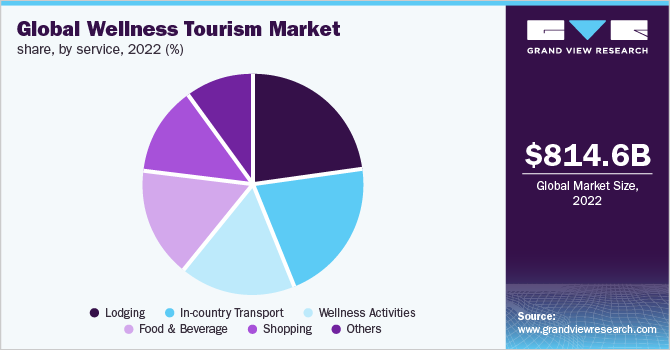
- By service, the lodging segment dominated in 2022 with a revenue share of 23.3%. Growth in this segment is supported by the expansion of luxury and high-end hotels and resorts in key tourist destinations. Lodging options range from tents, caravans, and campervans to hotels, motels, hostels, inns, private homes, and homestays, providing varied wellness experiences to travelers.
- By travel purpose, the secondary segment held the largest market share in 2022 and is expected to maintain dominance. Secondary wellness tourism refers to trips where wellness activities are not the primary motivation, often added to leisure or business travel. Spa treatments, fitness programs, and mental wellness activities are integrated into trips. According to GWI, secondary travel accounted for around 92.0% of wellness tourism trips in 2020, driven by the increasing incorporation of wellness services into international business travel.
- By travel type, the domestic segment accounted for a major share of the market in 2022 and is expected to continue leading. Rising domestic expenditure on wellness activities is driving growth, and the COVID-19 pandemic encouraged travelers to explore wellness destinations within their home countries due to international travel restrictions.
Market Size & Forecast
- 2022 Market Size: USD 814.6 Billion
- 2030 Projected Market Size: USD 2100 Billion
- CAGR (2023-2030): 12.42%
- North America: Largest market in 2022
Key Companies & Market Share Insights
The wellness tourism market is highly fragmented, with key players adopting strategies such as partnerships, mergers, and acquisitions to strengthen market presence. Notable examples include:
- In May 2022, Hilton signed an agreement with CKR Resort to launch the Hilton Hyderabad Resort & Spa in Hyderabad.
- In March 2019, OneSpaWorld, a provider of wellness services for resorts and cruise ships, partnered with Haymaker Acquisition Corp. to form OneSpaWorld Holdings Ltd., a new holding company.
Key Players
- Hilton
- Accor
- Hyatt Corporation
- Rancho La Puerta, Inc.
- Marriot International, Inc.
- Rosewood Hotel Group
- Niraamaya Wellness Retreat
- InterContinental Hotels Group
- Omni Hotels & Resorts
- Radisson Hospitality
- Four Seasons Hotels Limited
Explore Horizon Databook – The world's most expansive market intelligence platform developed by Grand View Research.
Conclusion
The global wellness tourism market is poised for significant growth, driven by increasing consumer focus on preventive health, holistic well-being, and luxury travel experiences. North America remains the leading market due to high disposable income and strong wellness awareness, while domestic tourism has gained prominence following COVID-19 travel restrictions. Secondary wellness tourism, combining health activities with leisure or business travel, continues to dominate. With ongoing investments in wellness infrastructure, lodging, and experiential services, the market is projected to reach USD 2100 billion by 2030, growing at a CAGR of 12.42%, reflecting the rising global emphasis on physical, mental, and spiritual well-being.