Water Quality Monitoring Systems Market: Sustainable Practices for a Thirsty World
The global water quality monitoring systems market was valued at USD 5.67 billion in 2024 and is expected to grow steadily, reaching USD 8.55 billion by 2030.
The global water quality monitoring systems market was valued at USD 5.67 billion in 2024 and is expected to grow steadily, reaching USD 8.55 billion by 2030. This growth represents a CAGR of 7.2% from 2025 to 2030. Market expansion is being driven by technological advancements, rising environmental awareness, increasingly stringent regulatory requirements, and the combined effects of climate change, urbanization, and industrialization, all of which have intensified the need for effective and continuous water quality monitoring.
Advances in sensor technologies and remote sensing systems have significantly improved the accuracy, reliability, and efficiency of water quality monitoring. At the same time, climate change impacts and escalating pollution levels from urban development and industrial operations have made ongoing and rigorous water assessments essential to protect water resources and support sustainable usage. Governments across the globe are implementing stricter water quality regulations to safeguard ecosystems and public health, thereby increasing demand for comprehensive monitoring solutions. These regulatory frameworks require routine measurement of critical parameters such as pH, dissolved oxygen, turbidity, heavy metals, and microbial contaminants. For example, the World Health Organization (WHO) establishes international water quality benchmarks through its Guidelines for Drinking-Water Quality (GDWQ), which serve as the basis for national water quality standards in many countries.
Growing public awareness of environmental sustainability and the importance of access to clean water has further strengthened demand for water quality monitoring systems. Governments, industries, and municipalities are increasingly investing in advanced monitoring technologies not only to meet regulatory obligations but also to demonstrate accountability and commitment to sustainable water management. As a result, advanced water quality monitoring solutions are being widely adopted to ensure compliance, minimize environmental impact, and maintain public trust.
Order a free sample PDF of the Water Quality Monitoring Systems Market Intelligence Study, published by Grand View Research.
Key Market Trends & Insights
- Regional Insights: North America dominated the global water quality monitoring systems market in 2024, accounting for more than 36.0% of total revenue. Growth in the region is supported by stringent regulatory frameworks and heightened awareness regarding water conservation and public health. Government agencies and environmental authorities have established strict pollution control and water quality standards, driving the adoption of advanced monitoring systems. Increased industrial activity, agricultural runoff, and improper waste disposal practices have further elevated pollution risks, reinforcing the need for continuous and accurate water monitoring.
- Type Insights: The sensors segment led the market in 2024, capturing over 80.0% of global revenue. This dominance is attributed to advancements in sensing technologies that enable higher precision and expanded application capabilities. Multi-parameter sensors, for instance, allow simultaneous measurement of multiple water quality indicators, improving operational efficiency and reducing costs. In addition, IoT-enabled sensors support real-time data collection and transmission, enabling smart water management, faster response times, and predictive maintenance. These advanced sensors are increasingly used in agricultural irrigation monitoring as well as in municipal water systems for large-scale infrastructure management.
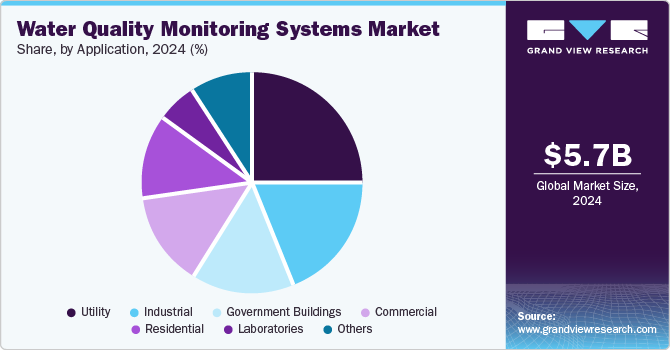
- Application Insights: The utility segment accounted for the largest revenue share in 2024. Utilities are responsible for meeting strict water quality standards and managing aging water infrastructure, which has led to increased adoption of advanced monitoring technologies. These systems help detect contaminants, optimize water treatment processes, and provide real-time insights for managing distribution networks, thereby reducing the risk of waterborne diseases. For example, under the Clean Water Act, state, tribal, and federal agencies monitor lakes, rivers, and streams to evaluate water conditions. Contributions from local governments, nongovernmental organizations, and volunteer groups further enhance data collection, enabling more effective identification of pollution sources and prioritization of corrective actions.
Market Size & Forecast
- 2024 Market Size: USD 5.67 Billion
- 2030 Projected Market Size: USD 8.55 Billion
- CAGR (2025-2030): 7.2%
- North America: Largest market in 2024
- Europe: Fastest growing market
Key Companies & Market Share Insights
Major players in the water quality monitoring systems market include General Electric Company, Danaher Corporation, and Xylem. These companies are actively pursuing strategies to expand their market presence and strengthen their competitive positioning. Key initiatives include partnerships, mergers and acquisitions, collaborations, and continuous development of new products and technologies. For instance, in January 2024, ABB acquired Real Tech Inc., a Canada-based company specializing in optical sensor technology for real-time water quality monitoring. This acquisition enhances ABB’s water segment portfolio by integrating Real Tech’s optical sensors and AI-driven analytics, supporting ABB’s broader strategy to advance smart water management solutions and expand its global environmental technology offerings.
Key Players
- General Electric Company
- Danaher Corporation
- Xylem
- Agilent Technologies, Inc.
- Teledyne Technologies Incorporated
- HORIBA, Ltd.
- Emerson Electric Co.
- Siemens
- Evoqua Water Technologies LLC
- Pentair
Explore Horizon Databook – The world's most expansive market intelligence platform developed by Grand View Research.
Conclusion
The global water quality monitoring systems market is positioned for consistent growth through 2030, driven by stricter environmental regulations, technological innovation, and rising concerns over water pollution and sustainability. The strong adoption of advanced sensor technologies, particularly in utilities and regulated regions such as North America, underscores the critical role of monitoring systems in protecting water resources and public health. As climate change, urbanization, and industrial expansion continue to place pressure on global water systems, investments in intelligent, real-time water quality monitoring solutions are expected to remain a key priority for governments and industries worldwide.