Wall Art Market 2030: Color Trends That Will Dominate Walls
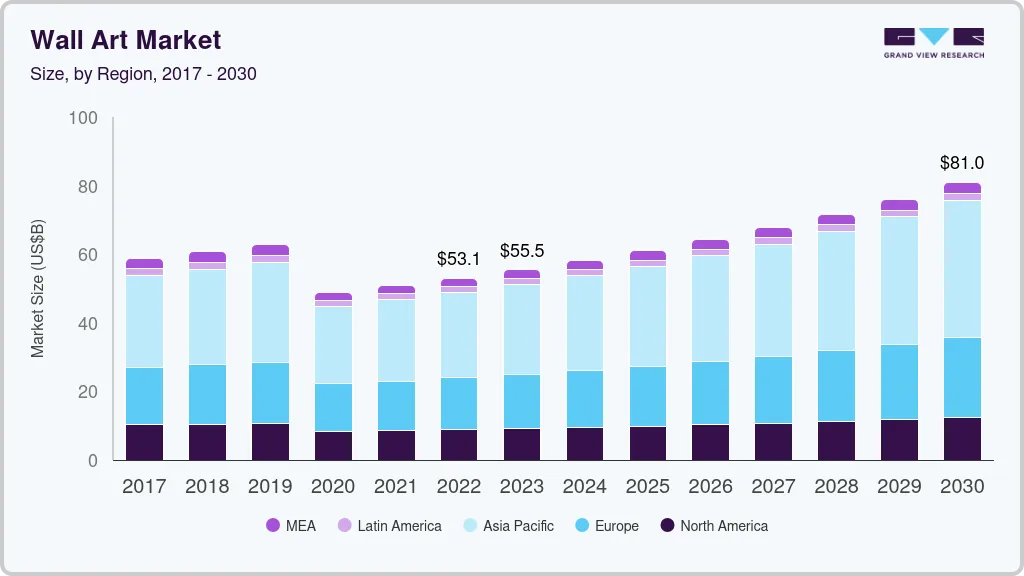
The global wall art market was valued at USD 53.05 billion in 2022 and is expected to reach USD 80.96 billion by 2030.
The global wall art market was valued at USD 53.05 billion in 2022 and is expected to reach USD 80.96 billion by 2030, expanding at a CAGR of 5.4% from 2023 to 2030. Market growth is primarily supported by rising demand for ready-to-install home décor solutions, increasing penetration of e-commerce platforms, and sustained growth in residential construction worldwide.
Consumer preferences remain a critical factor influencing market dynamics, as changing tastes and lifestyle choices directly impact demand patterns. Within the broader interior design industry, wall art represents a key decorative element, and evolving interior design trends significantly shape purchasing behavior across different wall art categories. For companies operating in this market, understanding and responding to shifting consumer expectations is essential to remain competitive and aligned with market needs.
A growing inclination toward minimalist interior design has notably influenced product demand. According to an online survey conducted by Rentcafe in September 2022, 59% of consumers expressed a preference for clean and minimal home aesthetics, driving the adoption of minimalist wall art designs. In response, manufacturers and designers are increasingly integrating minimalist styles into their portfolios by utilizing simplified techniques, subtle color palettes, and refined materials. Collaborations with artists specializing in minimalistic design are also becoming more common. Staying aligned with emerging trends and evolving design preferences is crucial for companies seeking long-term success in this dynamic market.
Modern consumers are increasingly seeking products that allow them to personalize living spaces, further driving demand for wall art. The COVID-19 pandemic amplified this trend by increasing focus on home remodeling and renovation activities, which, in turn, boosted wall art sales. Additionally, rapid growth in the real estate sector and the expansion of residential spaces such as apartments and single-family homes are contributing positively to market growth. The rise of the do-it-yourself (DIY) culture—largely fueled by pandemic-related lockdowns—has also played a significant role in increasing wall art adoption. Moreover, extensive product promotion through social media platforms such as Instagram and Pinterest has generated strong engagement among DIY enthusiasts worldwide, further supporting market expansion.
Order a free sample PDF of the Wall Art Market Intelligence Study, published by Grand View Research.
Key Market Trends & Insights
- Asia Pacific is expected to register a CAGR of 6.0% from 2023 to 2030. The Indian wall art market was valued at USD 4.3 billion in 2022, driven by increasing demand from the residential, lifestyle, and hospitality sectors. Growth in home real estate and evolving consumer lifestyles are supporting this trend. For example, IDECORWALA.COM, an online décor platform, is leveraging its e-commerce infrastructure, industry expertise, last-mile delivery, and installation services to penetrate the Indian market. Such initiatives present growth opportunities for market players to expand their offerings across residential, hospitality, and commercial segments.
- By type, the wallpaper wall art segment held the largest market share at 37.9% in 2022. Traditionally, demand for wallpapers and wallcoverings has been higher in Europe and Asia than in the Americas. However, the U.S. market has shown notable growth, with a 50% increase in wallpaper-related online searches in the 12 months leading up to March 2020. This growing interest is largely driven by younger consumers discovering wallpaper through social media platforms and appreciating its ease of customization. Advancements in removable wallpaper technology have further enhanced its appeal by addressing concerns related to installation and removal.
- By sales channel, the offline segment dominated the market with a share of over 65% in 2022. This dominance is attributed to rising demand for unique, customized, and premium wall art products. Specialty stores offer exclusive designs not commonly available through mass retailers and provide personalized customer service, expert guidance, and professional advice on selection, placement, and maintenance, which continue to attract consumers.
- By application, the residential segment accounted for approximately 70% of total revenue in 2022. Homeowners increasingly seek to personalize living spaces to reflect individual tastes, functionality, and aesthetic preferences. According to Porch.com, U.S. Google searches related to home improvement during June–August 2020 reached 330 million, representing nearly a 50% increase compared to the same period the previous year. This surge in home improvement activities is expected to continue supporting demand for wall art in residential settings.
Market Size & Forecast
- 2022 Market Size: USD 53.05 Billion
- 2030 Projected Market Size: USD 80.96 Billion
- CAGR (2023-2030): 5.4%
- Asia Pacific: Largest market in 2022
Key Companies & Market Share Insights
The global wall art market is highly competitive, with numerous players offering a wide range of artistic styles, materials, and formats. To strengthen their market positions, leading companies are focusing on product innovation, strategic partnerships, and expansion into untapped markets.
- In April 2023, Uprise Art organized an exhibition titled Universe, Understood in New York, featuring works by artists Evi O. and David Esquivel. The exhibition explored personal narratives and symbolism through vibrant abstraction, poetic expression, and subtle humor.
- In March 2023, Saatchi Art partnered with SuperRare, a curated NFT marketplace, to launch a collection of 10 exclusive digital artworks by global artists. Titled “Moments Past: Web3 & Memory,” the collection consisted of 1/1 NFTs released exclusively on the SuperRare platform via Saatchi Art.
Key Players
- VGL Group
- Art.com Inc.
- Uprise Art LLC
- Saatchi Art Limited
- Society6 LLC
- Minted LLC
- Artsy Inc
- 1stdibs.com Inc.
- Artnet Worldwide Corporation
- Artspace LLC
Explore Horizon Databook – The world's most expansive market intelligence platform developed by Grand View Research.
Conclusion
The global wall art market is positioned for steady growth, supported by increasing consumer interest in home personalization, rising residential construction, and the growing influence of e-commerce and social media platforms. Shifting design trends—particularly the move toward minimalism—along with the continued popularity of DIY home improvement projects, are reshaping product demand and innovation strategies. Asia Pacific remains a key growth region, while residential applications continue to dominate overall consumption. With ongoing innovation, strategic collaborations, and expansion into digital and emerging art formats, the wall art market is expected to reach USD 80.96 billion by 2030, growing at a CAGR of 5.4%, reflecting its evolving role within the global interior décor industry.