
Veterinary Regenerative Medicine Market 2030: Harnessing the Power of PRP
The global veterinary regenerative medicine market was valued at USD 257.54 million in 2022 and is projected to grow to USD 640.16 million by 2030, registering a compound annual growth rate (CAGR) of 12.54% from 2023 to 2030.
Veterinary Regenerative Medicine Market Overview
The global veterinary regenerative medicine market was valued at USD 257.54 million in 2022 and is projected to grow to USD 640.16 million by 2030, registering a compound annual growth rate (CAGR) of 12.54% from 2023 to 2030. This growth is driven by rising expenditures on pet care, increasing research and development efforts in regenerative medicine, the growing prevalence of both acute and chronic illnesses in companion animals, and initiatives undertaken by key market players.
For example, in July 2020, Boehringer Ingelheim enhanced its stem cell capabilities in veterinary medicine by acquiring Global Stem cell Technology (GST), a Belgian veterinary biotech firm. However, the COVID-19 pandemic had a significant effect on the market, causing restricted access to veterinary services, increased pet adoption, disruptions in the supply chain, operational limitations, and a temporary decline in demand. These challenges were compounded by broader macroeconomic pressures in 2022, which continued to affect market performance into the first quarter of 2023. A notable case is Bodevet's discontinuation of its StablePlate RX product for dogs, citing adverse market conditions and limited commercial viability despite price adjustments.
Order a free sample PDF of the Veterinary Regenerative Medicine Market Intelligence Study, published by Grand View Research.
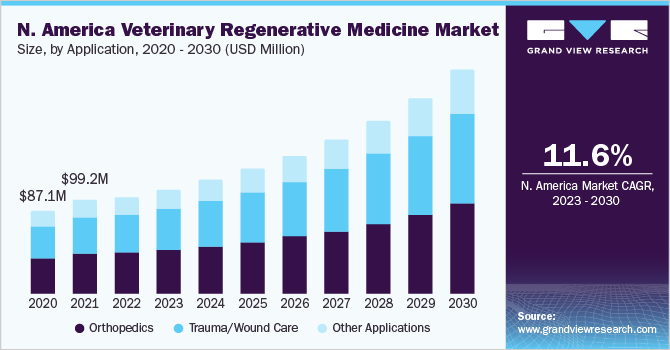
Regenerative medicine is increasingly being adopted in both human and veterinary health for treating various diseases. In veterinary applications, the field uses biological materials such as live cells, serum, and bone to help restore or repair damaged tissues and organs in animals. Current research highlights its effectiveness in treating orthopedic issues in companion animals, such as osteoarthritis and soft tissue injuries. This therapy is being used as a standalone treatment or alongside surgery, pharmaceuticals, and physical rehabilitation as part of a multimodal approach.
Key Market Trends and Insights
- By Application: The orthopedics segment accounted for the largest market share in 2022, comprising over 40% of the total. Meanwhile, the “Other Applications” segment is expected to grow at the fastest pace with a CAGR of approximately 13%, due to expanding applications of stem cell and platelet-rich plasma (PRP) therapies backed by growing clinical data.
- By Animal Type: Small animals (primarily cats and dogs) dominated the market in 2022 and are forecasted to continue as the fastest-growing segment at around 13% CAGR. This trend is driven by increasing pet ownership, the humanization of pets, rising cases of chronic diseases, and growing expenditure on pet healthcare.
- By Product: Stem cell-based products held the highest revenue share in 2022. This can be attributed to the increasing availability of stem cell therapies for animals like dogs, cats, and horses. For instance, Boehringer Ingelheim launched RenuTend in April 2022—a stem cell therapy designed to assist in the healing of tendon and ligament injuries in horses.
Market Size and Forecast
- 2022 Market Size: USD 257.54 Million
- 2030 Market Projection: USD 640.16 Million
- CAGR (2023–2030): 12.54%
- Leading Region (2022): North America
- Fastest Growing Region: Asia Pacific
Key Players and Market Share Overview
The global veterinary regenerative medicine market is characterized by the presence of numerous significant companies, making it relatively competitive. Market participants are actively pursuing strategies such as mergers and acquisitions, partnerships, new product launches, and expanded R&D to reinforce their market positions. For example, in September 2021, Dechra acquired the marketing and distribution rights for the ProVet BMC and ProVet APC systems from Hassinger Biomedical. These patented devices supported Dechra in expanding its offerings in the equine segment.
Prominent market players include:
- Boehringer Ingelheim International GmbH
- Zoetis
- Dechra
- ACell Inc. (Integra LifeSciences)
- Vetherapy
- VetStem, Inc.
- Ardent
- Enso Discoveries
- Animal Cell Therapies, Inc.
- Vetbiologics
Explore Horizon Databook – The world's most expansive market intelligence platform developed by Grand View Research.
Conclusion
The veterinary regenerative medicine market is on a strong growth trajectory, fueled by advancements in stem cell therapy, increased pet ownership, and a broader shift toward alternative and multimodal treatment approaches in veterinary care. Despite recent setbacks due to the pandemic and economic pressures, ongoing investments by leading players and the development of innovative products continue to enhance the market's potential. With robust growth expected through 2030, the field remains a dynamic and evolving segment of animal healthcare.