Vehicle Roadside Assistance Market: Key Players and Strategies
The global vehicle roadside assistance market was valued at USD 26.58 billion in 2024 and is expected to reach USD 35.36 billion by 2030.
The global vehicle roadside assistance market was valued at USD 26.58 billion in 2024 and is expected to reach USD 35.36 billion by 2030, expanding at a CAGR of 5.0% from 2025 to 2030. Vehicle roadside assistance provides emergency support to drivers facing unexpected issues such as flat tires, dead batteries, fuel shortages, lockouts, towing needs, or minor mechanical failures. The steady rise in global vehicle ownership, combined with increasing traffic congestion, has contributed to a higher frequency of breakdowns and accidents, thereby driving demand for roadside assistance services. Growing awareness of road safety and the introduction of subscription-based service models by major providers are also strengthening market growth.
The integration of advanced technologies—including artificial intelligence (AI), GPS, telematics, and IoT—is playing a significant role in enhancing roadside assistance operations. AI is used to optimize the dispatching of assistance vehicles, ensuring rapid response by analyzing real-time traffic conditions, location data, and the type of service required. Telematics enables vehicles to transmit diagnostics and performance data directly to service providers, allowing faster issue assessment and more accurate service delivery, ultimately reducing downtime for drivers.
Mobile applications have become essential tools for modern roadside assistance providers. These apps offer convenient features such as service requests, real-time tracking, in-app communication, and secure digital payments, significantly improving transparency and customer experience. As a result, the widespread adoption of mobile platforms is contributing to the overall expansion of the vehicle roadside assistance market.
Order a free sample PDF of the Vehicle Roadside Assistance Market Intelligence Study, published by Grand View Research.
Key Market Trends & Insights
- Regional Insights: Europe led the global vehicle roadside assistance market in 2024, capturing 35.7% of total revenue. The region’s market strength is supported by the presence of established service providers such as Viking Assistance Group AS, ARC Europe, Allianz Partners, and Falck A/S. For example, Falck A/S offers comprehensive towing, on-site repair, and subscription-based maintenance services throughout Europe.
- By Service Type: The towing segment held the largest revenue share at 32.2% in 2024. Increased road traffic and a growing number of vehicle breakdowns and accidents have driven the need for reliable towing services. The widespread availability of towing fleets worldwide, such as the 63,000+ towing and roadside service trucks operated by the American Automobile Association (AAA), continues to support segment growth.
- By Provider: Auto manufacturers accounted for the largest share in 2024, as many OEMs now integrate roadside assistance into vehicle warranties and service packages. This enhances customer satisfaction and ensures immediate support in the event of a breakdown.
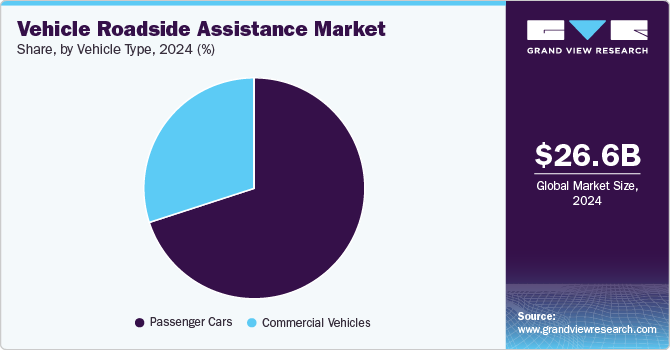
- By Vehicle Type: Passenger cars dominated the market in 2024. Rising sales of both electric and internal combustion engine passenger vehicles—including sedans, SUVs, and luxury cars—are driving demand for roadside support services. According to the International Energy Agency, SUVs accounted for 48% of global car sales in 2023, a trend driven by comfort features, brand perception, and bundled services such as roadside assistance.
Market Size & Forecast
- 2024 Market Size: USD 26.58 Billion
- 2030 Projected Market Size: USD 35.36 Billion
- CAGR (2025-2030): 5.0%
- Europe: Largest market in 2024
Key Companies & Market Share Insights
Prominent companies in the roadside assistance market include Ford Motor Company, Chevrolet, and Nissan Motor Co., Ltd. The competitive landscape is evolving as providers invest in large service networks, brand reliability, and technology-driven solutions. AI-enabled platforms, mobile apps, and on-demand services introduced by startups and digital disruptors are reshaping the industry. Key players are also focusing on product launches, partnerships, and geographic expansion.
- Ford Motor Company manufactures a diverse range of vehicles, including trucks, SUVs, luxury models, and electrified vehicles. Its roadside assistance service covers towing, tire and battery assistance, and additional support options.
- Nissan Motor Co., Ltd., known for its wide range of sedans, SUVs, sports cars, and light commercial vehicles under the Nissan and Infiniti brands, offers roadside assistance for mechanical breakdowns, jump starts, fuel delivery, and other essential services.
Key Players
- GEICO
- Viking Assistance Group AS
- ARC Europe
- Allstate Insurance Company
- Agero, Inc.
- Prime Assistance Inc.
- SOS International A/S
- Allianz Partners
- American Automobile Association
- Best Roadside Service
- Access Roadside Assistance
- National General Motor Club
- Liberty Mutual Insurance
- Chevrolet
- Ford Motor Company
- Nissan Motor Corporation.
Explore Horizon Databook – The world's most expansive market intelligence platform developed by Grand View Research.
Conclusion
The global vehicle roadside assistance market is poised for steady expansion as vehicle ownership rises, mobility patterns evolve, and road safety awareness grows. With the market projected to increase from USD 26.58 billion in 2024 to USD 35.36 billion by 2030, advancements in AI, telematics, and mobile platforms are enhancing service efficiency and response times. Europe remains the leading region, while growing customer expectations for seamless, tech-enabled support are reshaping service delivery models worldwide. As automakers integrate roadside assistance into their vehicle offerings and digital providers introduce innovative on-demand solutions, the market is expected to continue evolving toward more connected, responsive, and customer-centric service models.