Unmanned Systems Market 2030: Military Applications Redefined
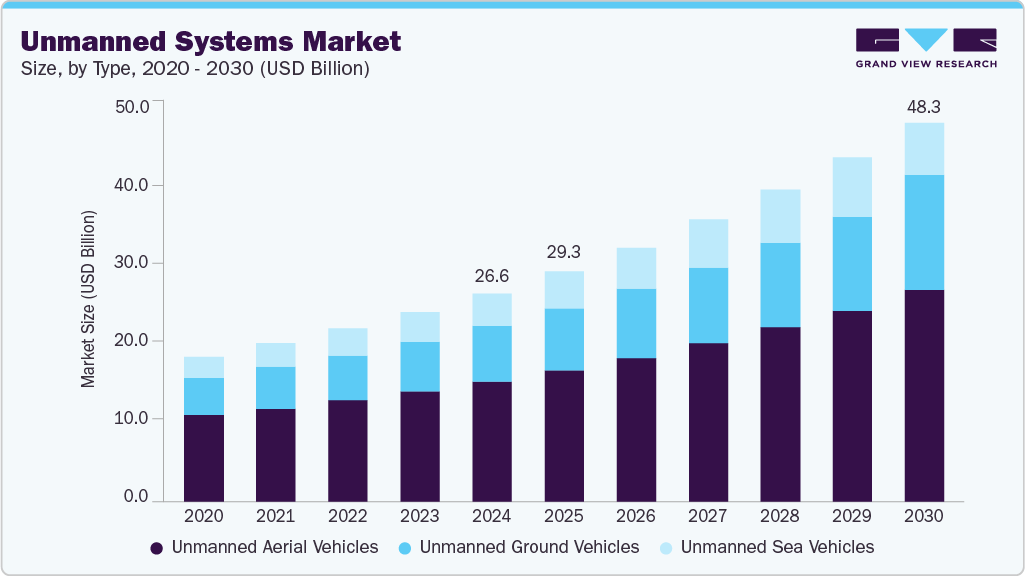
The global unmanned systems market was valued at USD 26.55 billion in 2024 and is expected to reach USD 48.31 billion by 2030.
The global unmanned systems market was valued at USD 26.55 billion in 2024 and is expected to reach USD 48.31 billion by 2030, reflecting a CAGR of 10.5% from 2025 to 2030. Market expansion is primarily driven by rising demand for automation across defense, commercial, and industrial applications. Innovations in artificial intelligence, sensor systems, and real-time data analytics are enabling the development of highly capable unmanned aerial, ground, and maritime platforms. Additionally, increasing defense expenditures and heightened requirements for surveillance, reconnaissance, and border protection are accelerating military adoption. In the commercial sphere, growing use in agriculture, logistics, and infrastructure monitoring is broadening market penetration. Together, these developments contribute to a strong outlook for the industry.
Escalating geopolitical tensions and cross-border disputes continue to significantly boost demand for unmanned systems within defense operations. Governments are allocating larger budgets toward autonomous aerial, ground, and underwater platforms designed for intelligence, surveillance, and reconnaissance (ISR). With evolving combat strategies, unmanned technologies present safer and more cost-efficient alternatives for high-risk missions. Collaboration between major defense contractors and government entities is further advancing research, development, and deployment, reinforcing long-term industry growth.
There is also increasing focus on autonomous surface and underwater vehicles for oceanographic research, seabed mapping, and naval missions. These systems reduce risks associated with deep-sea operations and support extended underwater monitoring. In the energy and offshore industries, unmanned maritime platforms are increasingly deployed for pipeline inspections and environmental assessments. Progress in underwater communication and propulsion technologies is improving reliability and operational endurance, making maritime applications a critical growth avenue for the unmanned systems market.
Order a free sample PDF of the Unmanned Systems Market Intelligence Study, published by Grand View Research.
Key Market Trends & Insights
- Regional Trends: North America held more than 45% of global revenue in 2024, supported by expanding defense modernization efforts and heightened cross-border surveillance demands. The region is experiencing rapid technological progress, with U.S. and Canadian agencies accelerating deployment of UAVs, UGVs, and maritime drones for homeland security and disaster response. This momentum is driving investment in AI-based autonomy, interoperable payloads, and hybrid propulsion.
- By Type: Unmanned aerial vehicles (UAVs) led the market with over 57% revenue share in 2024. AI and autonomous technologies are reshaping UAV missions by enabling real-time analytics, adaptive navigation, and minimal operator input. Advancements in swarm intelligence and machine learning are opening new opportunities across defense and commercial uses, improving mission efficiency and reducing operational costs.
- By Technology: Semi-autonomous systems accounted for the largest share in 2024. These platforms offer enhanced safety by allowing human intervention during complex scenarios, supporting regulatory compliance in commercial airspace and industrial environments. Because regulators view semi-autonomy as a transitional step toward full autonomy, these systems benefit from faster approval and broader adoption.
- By Application: Military and law enforcement represented a substantial portion of the market in 2024. There is a strong trend toward interoperability across aerial, ground, and maritime platforms. Agencies are investing in integrated systems capable of collaborative operations and data sharing in contested environments, improving situational awareness and mission effectiveness.
Market Size & Forecast
- 2024 Market Size: USD 26.55 Billion
- 2030 Projected Market Size: USD 48.31 Billion
- CAGR (2025-2030): 10.5%
- North America: Largest market in 2024
- Asia Pacific: Fastest growing market
Key Companies & Market Share Insights
Leading market participants include Northrop Grumman Corporation, Boeing, and emerging players such as Teledyne Technologies Inc. and Textron Inc.
- Northrop Grumman Corporation is a major defense technology provider known for advanced UAS platforms like the RQ-4 Global Hawk and MQ-4C Triton. The company’s integration of AI and multi-domain capabilities strengthens its competitive position in ISR-focused autonomous systems.
- Boeing, through Insitu and platforms such as the MQ-25 Stingray, is advancing unmanned aviation with solutions emphasizing endurance, autonomy, and network-centric operations. Its strong aerospace background supports innovation in both military and commercial unmanned systems.
- Teledyne Technologies Inc. is expanding its footprint in unmanned underwater vehicles (UUVs) and remote sensing systems. Its focus on marine robotics makes it a rising player in oceanography, offshore energy, and defense-related maritime applications.
- Textron Inc., via Textron Systems, is strengthening its presence with tactical unmanned solutions such as the Aerosonde and Shadow UAS. The company is investing heavily in autonomous technologies aimed at surveillance, target acquisition, and border protection missions.
Key Players
- Northrop Grumman
- Lockheed Martin Corporation
- Teledyne Technologies Inc.
- BAE Systems
- DJI
- Thales
- Israel Aerospace Industries
- Boeing
- General Dynamics Corporation
- Textron Inc.
- L3Harris Technologies Inc.
- Elbit Systems Ltd.
Explore Horizon Databook – The world's most expansive market intelligence platform developed by Grand View Research.
Conclusion
The unmanned systems market is entering a phase of sustained expansion, supported by strong defense demand, rapid technological advancements, and growing commercial applications. With the market projected to rise from USD 26.55 billion in 2024 to USD 48.31 billion by 2030, unmanned technologies are poised to play an increasingly critical role in security, industrial operations, and environmental monitoring. Regional leadership from North America, emerging growth in Asia Pacific, and continued innovation from key industry players will shape competitive dynamics. As autonomy, AI integration, and multi-domain interoperability advance, the industry will continue to move toward more efficient, adaptable, and mission-ready unmanned platforms across air, land, and sea.