Transcranial Magnetic Stimulation System Market: Empowering Patients with New Technologies
The global transcranial magnetic stimulation (TMS) system market was valued at USD 256.53 million in 2024 and is projected to reach USD 594.49 million by 2033.
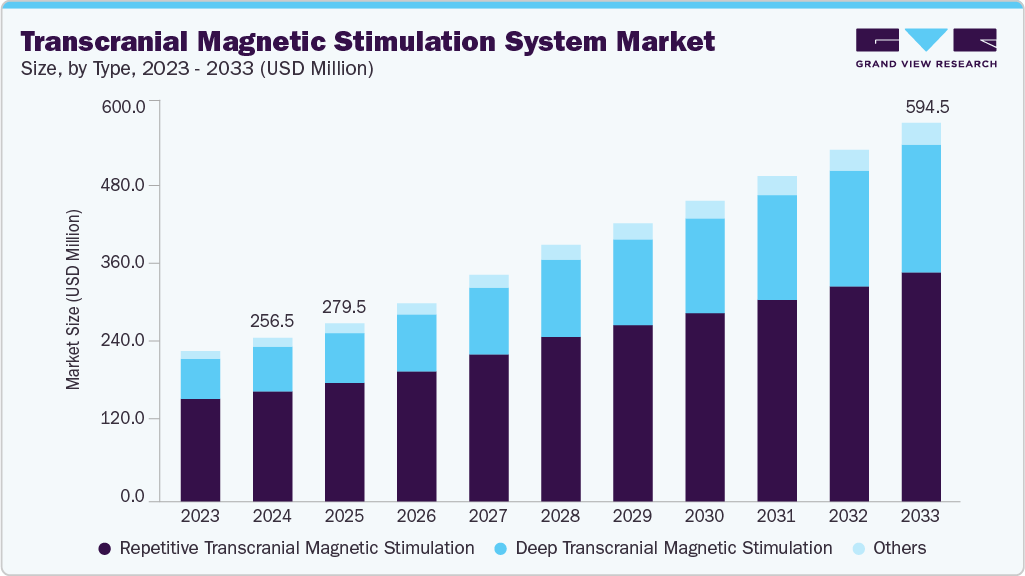
The global transcranial magnetic stimulation (TMS) system market was valued at USD 256.53 million in 2024 and is projected to reach USD 594.49 million by 2033, expanding at a CAGR of 9.89% from 2025 to 2033. Growth is being driven by rising awareness of neurological disorders, the increasing prevalence of mental health conditions, and a growing number of clinical trials aimed at enhancing TMS technologies.
Expanding adoption of TMS systems in hospitals and healthcare facilities, along with greater penetration in both developed and emerging markets, is contributing significantly to market expansion. The rising prevalence of conditions such as epilepsy, Parkinson’s disease, Alzheimer’s disease, obsessive-compulsive disorder (OCD), and depression is a major driver. According to WHO data published in February 2024, around 50 million people globally live with epilepsy, while an April 2024 Alzheimer's Association report estimates 6.90 million Americans aged 65 and older are affected by Alzheimer’s dementia.
Further data underscore the substantial behavioral health burden: in August 2025, the WHO reported that 5.7% of the global adult population suffers from depressive disorders. A February 2024 study from the National Library of Medicine found that OCD affects 1% to 3% of the global population. These conditions heighten the demand for effective, non-invasive treatment options such as TMS, which uses magnetic fields to modulate brain activity and has demonstrated effectiveness in treating depression and potential utility in other neurological disorders.
The burden of neurological disorders remains high across both developed and developing regions, amplifying the need for advanced therapies. For example, the National Institute of Mental Health reported that 21.0 million U.S. adults experienced at least one major depressive episode in 2021, representing 8.3% of the adult population. This ongoing prevalence reinforces the growing reliance on TMS systems as an alternative or adjunct to traditional pharmacological treatments.
Order a free sample PDF of the Transcranial Magnetic Stimulation System Market Intelligence Study, published by Grand View Research.
Key Market Trends & Insights
- North America Leading the Market: North America accounted for 57.59% of global revenue in 2024. The region’s leadership is driven by the high prevalence of neurological and psychiatric conditions—including depression, anxiety, Parkinson’s disease, and Alzheimer’s disease—combined with growing awareness of non-invasive therapeutic options. Limitations of traditional medications have also accelerated the adoption of TMS in the U.S. and Canada, particularly for treatment-resistant cases.
- rTMS Dominating by Type: The Repetitive Transcranial Magnetic Stimulation (rTMS) segment held 67.34% of the market in 2024. rTMS is the most widely used form of TMS therapy, administering repeated magnetic pulses to targeted areas of the brain over multiple sessions. It is primarily utilized for major depressive disorder (MDD) and has shown strong clinical effectiveness for patients who have not achieved adequate results with conventional therapies.
- Alzheimer’s Disease Expected to Grow Fastest by Application: The Alzheimer’s disease segment is projected to grow at the fastest CAGR of 16.13% during the forecast period. Rising global prevalence and continuous advancements in neurostimulation research are increasing interest in TMS as a potential non-invasive treatment for cognitive decline. Research and trials are increasingly focused on improving neural connectivity and cognitive function in individuals with Alzheimer's disease, supporting strong future demand.
- Adults Segment Leading by Age Group: The adults segment held the largest revenue share in 2024. Adults are more frequently diagnosed with conditions such as major depressive disorder and other mental health disorders effectively treated by TMS. Most approved TMS systems and regulatory guidelines currently focus on adult use, reinforcing the segment’s dominance. While ongoing research is expanding indications for younger populations, adults remain the primary drivers of market growth.
Market Size & Forecast
- 2024 Market Size: USD 256.53 Million
- 2033 Projected Market Size: USD 594.49 Million
- CAGR (2025-2033): 9.89%
- North America: Largest market in 2024
Key Companies & Market Share Insights
The TMS system market is moderately fragmented, characterized by competition among both global and regional players. As companies intensify efforts to increase market share, competitive pressure is expected to rise further. Many participants are leveraging strategies such as product launches, mergers and acquisitions, and geographic expansion to strengthen their positions. These ongoing strategic initiatives are expected to support steady market growth throughout the forecast period.
Key Players
- Nexstim
- BrainsWay
- Magstim (Welcony)
- MagVenture A/S
- eNeura, Inc.
- NeuroStar (Neuronetics)
- Neurosoft
- CloudNeuro
- Soterix Medical Inc.
- Brain Ultimate Inc.
- DEYMED Diagnostic s.r.o.
- Salience TMS (Salience Health)
- NeuroQore (Ontario Brain Institute)
- SEBERS Medical
- neurocare group AG (MAG & More)
- Shenzhen Yingchi Technology Co., Ltd.
- Shanghai Goodmed Medical Device Co., Limited
- Guangzhou MeCan Medical Limited
- Others
Explore Horizon Databook – The world's most expansive market intelligence platform developed by Grand View Research.
Conclusion
The global transcranial magnetic stimulation system market is poised for strong growth through 2033, supported by rising prevalence of neurological and psychiatric disorders, increasing awareness of non-invasive treatment options, and continued advancements in TMS technologies. North America remains the leading market due to high disease prevalence and strong adoption of innovative therapies. With rTMS dominating current usage and Alzheimer’s disease emerging as the fastest-growing application, TMS systems are becoming an essential tool in modern neurological and psychiatric care. As research expands and clinical acceptance grows worldwide, the TMS market is expected to continue its upward trajectory, offering new therapeutic possibilities for millions of patients.