Stick Packaging Market 2033: Customization and Personalization Trends
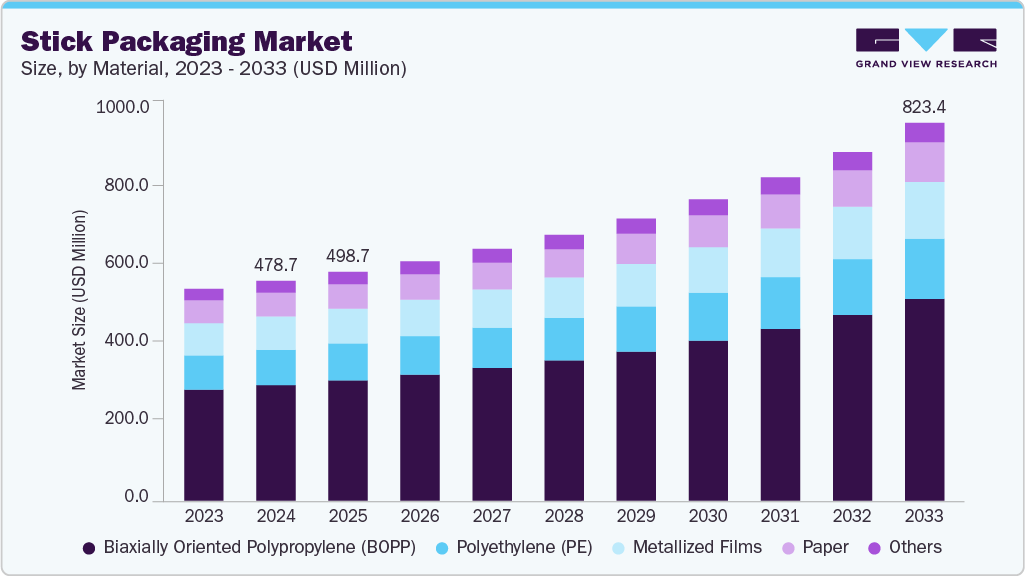
The global stick packaging market was valued at USD 478.7 million in 2024 and is projected to reach USD 823.4 million by 2033.
The global stick packaging market was valued at USD 478.7 million in 2024 and is projected to reach USD 823.4 million by 2033, registering a CAGR of 6.5% from 2025 to 2033. Market growth is primarily supported by the increasing demand for convenient, single-serve, and portable packaging solutions across the food, beverage, and pharmaceutical industries.
Rising consumer preference for lightweight, sustainable, and user-friendly packaging formats continues to support market expansion. Rapid urbanization and fast-paced lifestyles have driven demand for compact packaging solutions, particularly for food, beverages, nutraceuticals, and pharmaceutical products. Stick packs offer advantages such as portability, minimal storage requirements, and ease of use, making them suitable for products including instant coffee, powdered drink mixes, energy gels, dietary supplements, and condiments. This shift toward convenience-oriented packaging is especially prominent among millennials and working professionals who value portion control and on-the-go consumption.
The flexibility of stick packaging has resulted in its adoption across a wide range of end-use industries. Within the food and beverage sector, stick packs are increasingly used for sugar, salt, spices, and powdered beverages, helping preserve freshness and reduce contamination risks. In pharmaceuticals and nutraceuticals, they are commonly used for powdered medications, oral rehydration salts, and dietary supplements, ensuring accurate dosing and improved consumer compliance. The pharmaceutical industry, in particular, prefers stick packaging due to its hygienic, single-use format that maintains product integrity and reduces wastage. The growing diversity of applications continues to drive market growth globally.
Sustainability has emerged as a key driver shaping the stick packaging industry. Manufacturers are increasingly adopting environmentally friendly materials such as recyclable mono-layer films, biodegradable plastics, and paper-based laminates. These developments support global sustainability objectives while appealing to environmentally conscious consumers. Additionally, improvements in barrier technologies have enhanced protection against moisture and oxygen, extending product shelf life without compromising environmental goals. Investments in lightweight and resource-efficient packaging solutions further reduce transportation-related emissions and support long-term market growth.
Order a free sample PDF of the Stick Packaging Market Intelligence Study, published by Grand View Research.
Key Market Trends & Insights
- Asia Pacific held the largest market share of over 36.0% in 2024. The region has experienced strong growth in convenience-driven consumption, particularly for ready-to-drink beverages, instant coffee, and powdered food products. Countries such as China, India, and Japan benefit from widespread on-the-go lifestyles among younger populations. Growth in food service, online retail, and e-commerce has further increased the adoption of stick packaging for single-serve powdered beverages, health supplements, and condiments.
- By material, the BOPP segment accounted for over 52.0% of revenue in 2024 and is expected to grow at the fastest CAGR of 6.7% during the forecast period. BOPP is widely used due to its strong mechanical properties, moisture resistance, and clarity. Its biaxial orientation improves barrier performance and tensile strength, making it suitable for food, pharmaceutical, and cosmetic applications. BOPP films are lightweight, printable, and sealable, enhancing branding and shelf visibility for products such as instant coffee, sugar, drink mixes, and nutritional supplements.
- By end use, the food & beverages segment dominated the market with a share of over 41.0% in 2024 and is projected to grow at the fastest CAGR of 6.7% through the forecast period. Growth is supported by the need for convenience, portion control, and longer shelf life. Applications include instant coffee sticks, powdered beverages, sugar sticks, energy drink powders, and snack products. Laminated films, paperboard, and plastic composites are commonly used to protect contents from moisture, oxygen, and light.
Market Size & Forecast
- 2024 Market Size: USD 478.7 Million
- 2033 Projected Market Size: USD 823.4 Million
- CAGR (2025-2033): 6.5%
- Asia Pacific: Largest Market in 2024
- North America: Fastest Growing Market
Key Companies & Market Share Insights
Leading players in the stick packaging market are focusing on expansion strategies, strategic partnerships, and product innovation to strengthen their market presence. These initiatives are aimed at improving production capabilities, expanding geographic reach, and meeting the evolving demand for sustainable and convenient packaging solutions.
Key Players
- Amcor plc
- Constantia Flexibles
- Glenroy, Inc.
- Catalent, Inc
- Huhtamaki
- ePac Holdings, LLC
- Taghleef Industries
- Polynova Industries Inc
- Elitefill
- Kimac Industries
- CarePac
- ProAmpac
- Qingdao Haide Packaging Co., Ltd
Explore Horizon Databook – The world's most expansive market intelligence platform developed by Grand View Research.
Conclusion
The global stick packaging market is expected to witness steady growth through 2033, supported by rising demand for portable, single-serve packaging across food, beverage, and pharmaceutical sectors. Increasing emphasis on sustainability, combined with technological advancements in packaging materials and barrier performance, will continue to shape industry dynamics. Strong growth in Asia Pacific and accelerating adoption in North America highlight the market’s global potential, while ongoing investments and strategic initiatives by key players are likely to enhance competitiveness and long-term market expansion.