Lithium-ion Battery Recycling Market Growth: Stats and Predictions
The global lithium-ion battery recycling market was valued at USD 198.37 million in 2024 and is expected to reach USD 1,830 million by 2030.
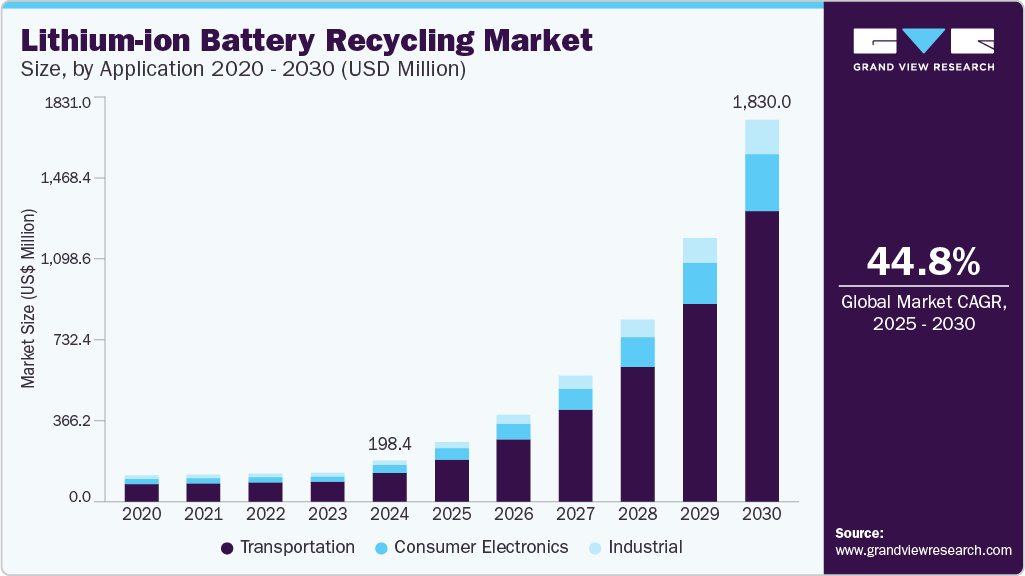
The global lithium-ion battery recycling market was valued at USD 198.37 million in 2024 and is expected to reach USD 1,830 million by 2030, expanding at a CAGR of 44.8% from 2025 to 2030. Rapid growth in this market is largely attributed to the rising adoption of electric vehicles (EVs) and the widespread use of consumer electronic devices.
According to the International Energy Agency (IEA), global electric car sales exceeded 2.3 million units, reflecting a 25% increase compared to the previous year. Projections indicated that approximately 14 million electric vehicles would be sold by the end of 2023, representing an annual growth rate of 35%, driven primarily by increased purchases during the second half of the year. This accelerating adoption of EVs is significantly increasing demand for lithium-ion batteries and, consequently, the need for effective recycling solutions.
Lithium-ion battery recycling has become a vital component of the global transition toward sustainability and renewable energy adoption. Growing demand for lithium-ion batteries across consumer electronics, renewable energy storage systems, and EVs has resulted in a substantial increase in battery waste. For example, data from the Commonwealth Scientific and Industrial Research Organization (CSIRO) indicates that lithium-ion battery waste in Australia is increasing at an annual rate of 20%, while only 10% of total battery waste was recycled in 2021. These trends highlight the substantial opportunity for market participants to address environmental challenges while benefiting from the increasing focus on sustainable battery solutions.
Market growth is further supported by rising volumes of battery waste, government incentives promoting recycling, and growing consumer awareness regarding environmental protection. In February 2022, Glencore and Britishvolt entered into a joint venture aimed at establishing a battery recycling ecosystem in the United Kingdom. While the transition to a circular economy presents challenges such as high capital investment requirements and regulatory complexities, it also creates significant opportunities for innovation, collaboration, and long-term value creation. Intensifying competition among industry players continues to drive technological advancements and partnerships across the recycling value chain.
Order a free sample PDF of the Lithium-ion Battery Recycling Market Intelligence Study, published by Grand View Research.
Key Market Trends & Insights
- Regional Insights: Asia Pacific held the largest revenue share of the global lithium-ion battery recycling market in 2024. Market growth in the region is driven by the availability of low-cost batteries, rapid EV adoption fueled by increased awareness of sustainable mobility, and strong demand for consumer electronics. Additionally, population growth in major economies such as China and India continues to support rising battery consumption, further accelerating recycling demand.
- Application Insights: The transportation segment dominated the market with a revenue share of 69.79% in 2024. Lithium-ion batteries are widely preferred in transportation due to their high energy density, long cycle life, low memory effect, and fast recharge capabilities. Recycled batteries are increasingly being repurposed for stationary energy storage applications within the automotive sector, supporting grid stabilization and renewable energy integration. Similarly, the electronics industry reuses recovered battery materials to manufacture products such as smartphones, wearables, and computers, reducing reliance on virgin raw materials.
Market Size & Forecast
- 2024 Market Size: USD 198.37 Million
- 2030 Projected Market Size: USD 1,830 Million
- CAGR (2025-2030): 44.8%
- Asia Pacific: Largest market in 2024
Key Companies & Market Share Insights
Major players operating in the lithium-ion battery recycling market include Contemporary Amperex Technology Co., Limited (CATL), LG Energy Solution, Panasonic Corporation, and SAMSUNG SDI CO., LTD. These companies are actively investing in innovation, sustainability initiatives, and recycling technologies to strengthen their market positions.
- Contemporary Amperex Technology Co., Limited is recognized for continuous advancements in battery technology, particularly its leadership in cobalt-free Lithium Ferro Phosphate (LFP) batteries, which offer improved safety and environmental benefits.
- LG Energy Solution focuses on the design and production of lithium-ion batteries for electric vehicles, IT applications, energy storage systems, and mobility solutions, contributing to the advancement of clean and sustainable energy ecosystems.
Key Players
- Contemporary Amperex Technology Co., Limited
- LG Energy Solution
- Panasonic Corporation
- SAMSUNG SDI CO., LTD.
- BYD
- SVOLT Energy
- Tesla
- Shenzhen Manly Battery Co.
- TOSHIBA CORPORATION
- SK on Co., Ltd
- CALB
- Gotion, Inc.
- Sunwoda Electronic Co., Ltd
- Li-Cycle Corp.
- Helbiz
Explore Horizon Databook – The world's most expansive market intelligence platform developed by Grand View Research.
Conclusion
The lithium-ion battery recycling market is set for exceptional growth, driven by the rapid expansion of electric vehicle adoption, rising battery waste volumes, and increasing emphasis on sustainability and circular economy practices. With the market projected to grow from USD 198.37 million in 2024 to USD 1,830 million by 2030 at a CAGR of 44.8%, recycling solutions will play a critical role in securing raw material supply, reducing environmental impact, and supporting renewable energy integration. Despite challenges related to capital investment and regulatory compliance, continued innovation, government support, and industry collaboration are expected to unlock significant long-term opportunities for market participants.