Law Enforcement Software Market Analysis: Challenges and Opportunities Ahead
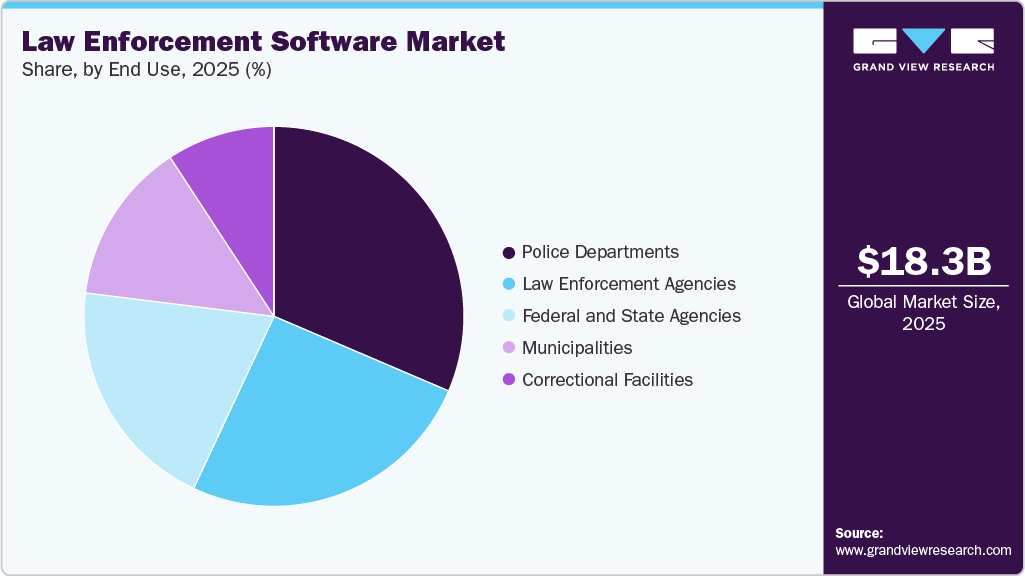
The global law enforcement software market was valued at USD 18.26 billion in 2025 and is expected to reach USD 40.76 billion by 2033.
The global law enforcement software market was valued at USD 18.26 billion in 2025 and is expected to reach USD 40.76 billion by 2033, registering a CAGR of 10.4% during the forecast period from 2026 to 2033. Market expansion is primarily driven by the growing demand for advanced digital solutions that enhance public safety, optimize criminal investigations, and improve overall operational efficiency within law enforcement agencies.
Increasing crime rates, the rising adoption of digital evidence management systems, and the integration of artificial intelligence (AI), advanced analytics, and cloud technologies are significantly accelerating market growth. As criminal activities become more complex and technology-driven, law enforcement agencies are increasingly deploying sophisticated software solutions such as records management systems (RMS), computer-aided dispatch (CAD), and digital evidence management platforms. These tools help improve data accuracy, enable real-time decision-making, and streamline workflows. For example, in October 2025, West Midlands Police in the UK advanced its digital transformation by integrating secure AI capabilities through Android Enterprise devices. This initiative replaced traditional, time-intensive processes with AI-driven guidance and real-time access to police records, allowing officers to reduce administrative tasks and focus more on community engagement and public safety.
Government investments in modernizing public safety infrastructure through smart policing initiatives are further contributing to market growth. In March 2024, the Port Authority Police Department of New York and New Jersey launched a USD 15 million modernization program aimed at upgrading law enforcement technologies. The initiative included the deployment of data analytics platforms for crime insights, mobile-first reporting solutions, and improved dispatch systems to enhance response efficiency. Additionally, the increasing adoption of cloud-based and AI-driven analytics solutions is enabling predictive policing, faster incident response, and improved threat detection, thereby supporting industry expansion. AI, big data analytics, and IoT technologies are increasingly used to process large datasets, identify crime patterns, and anticipate potential risks, particularly in North America and Europe, where digital policing reforms are strongly emphasized.
Furthermore, growing public safety concerns driven by rapid urbanization and rising geopolitical tensions have intensified demand for real-time surveillance and crime analysis tools. The shift toward interoperable and scalable software platforms enables secure intelligence sharing across jurisdictions, strengthening collaboration and crime-solving capabilities. At the same time, private sector involvement in developing advanced cybersecurity and data protection solutions ensures compliance with stringent data privacy regulations, further reinforcing market growth.
Order a free sample PDF of the Law Enforcement Software Market Intelligence Study, published by Grand View Research.
Key Market Trends & Insights
- Regional Insights: North America accounted for the largest revenue share of 34.1% in 2025, driven by early adoption of advanced technologies such as AI, predictive analytics, and biometrics. Strong government funding and efforts to enhance interoperability among federal, state, and local agencies continue to support market dominance. Rising cybercrime and the need for digital evidence management have further boosted adoption.
- Component Insights: The solutions segment led the market with a 67.0% revenue share in 2025. This growth is attributed to increasing demand for modular and customizable platforms that integrate case management, incident tracking, and digital forensics into a unified system, reducing administrative complexity.
- Deployment Insights: Cloud-based deployments dominated the market in 2025 due to their scalability, flexibility, and cost efficiency. Cloud solutions allow agencies to securely store and analyze large volumes of data, including video evidence and incident reports, while supporting inter-agency collaboration. Hybrid and multi-cloud models are also gaining traction.
- End-Use Insights: The municipalities segment is projected to grow at the fastest CAGR from 2026 to 2033, supported by smart city initiatives and the need for integrated public safety management systems that enhance coordination, situational awareness, and emergency response.
Market Size & Forecast
- 2025 Market Size: USD 18.26 Billion
- 2033 Projected Market Size: USD 40.76 Billion
- CAGR (2026-2033): 10.4%
- North America: Largest Market in 2025
- Asia Pacific: Fastest Growing Market
Key Companies & Market Share Insights
Major players in the law enforcement software market include Tyler Technologies, Axon Enterprise, Hexagon, Wolters Kluwer N.V., Datamaran, and OneTrust, LLC. These companies are actively pursuing strategies such as product innovation, partnerships, collaborations, and agreements to strengthen their market positions. Notable developments include:
- October 2025: Axon Enterprise, Inc. enhanced its public safety ecosystem with AI-powered and real-time capabilities, integrating 911 intelligence, community collaboration, and officer connectivity through solutions such as Axon Assistant and Axon Air Drone as First Responder.
- September 2025: TRULEO expanded its AI Analyst tool to support police leadership by automating reporting, compliance documentation, and records management, while enabling performance tracking and crime analysis through advanced data visualizations.
- February 2025: Flock Safety launched Flock Nova and FreeForm, two AI-driven tools designed to accelerate investigations. Flock Nova consolidates data from multiple sources, including CAD, RMS, and open-source intelligence, into a unified platform and supports secure inter-agency data sharing.
Key Players
- Axon Enterprise, Inc.
- Datamaran
- EcoVadis
- FactSet
- Hexagon
- LSEG
- NAVEX Global, Inc.
- NEC Corporation
- TRULEO
- OneTrust, LLC.
- SAS Institute Inc.
- Sustainalytics
- Tyler Technologies, Inc.
- Verisk Analytics, Inc.
- Wolters Kluwer N.V.
Explore Horizon Databook – The world's most expansive market intelligence platform developed by Grand View Research.
Conclusion
The global law enforcement software market is poised for robust growth through 2033, driven by rising crime complexity, increased government investments, and rapid technological advancements in AI, cloud computing, and data analytics. As agencies worldwide prioritize digital transformation, interoperable platforms, and data-driven policing, demand for comprehensive and scalable software solutions will continue to rise. With strong momentum in North America and accelerating adoption in Asia Pacific, the market is expected to play a critical role in shaping the future of public safety, enabling more efficient, transparent, and proactive law enforcement operations globally.