
How Fischer Fasteners Strengthen Structural Safety and Long Term Stability in Modern Construction
That is where Fischer fasteners and engineered structural fixing solutions enter the conversation.
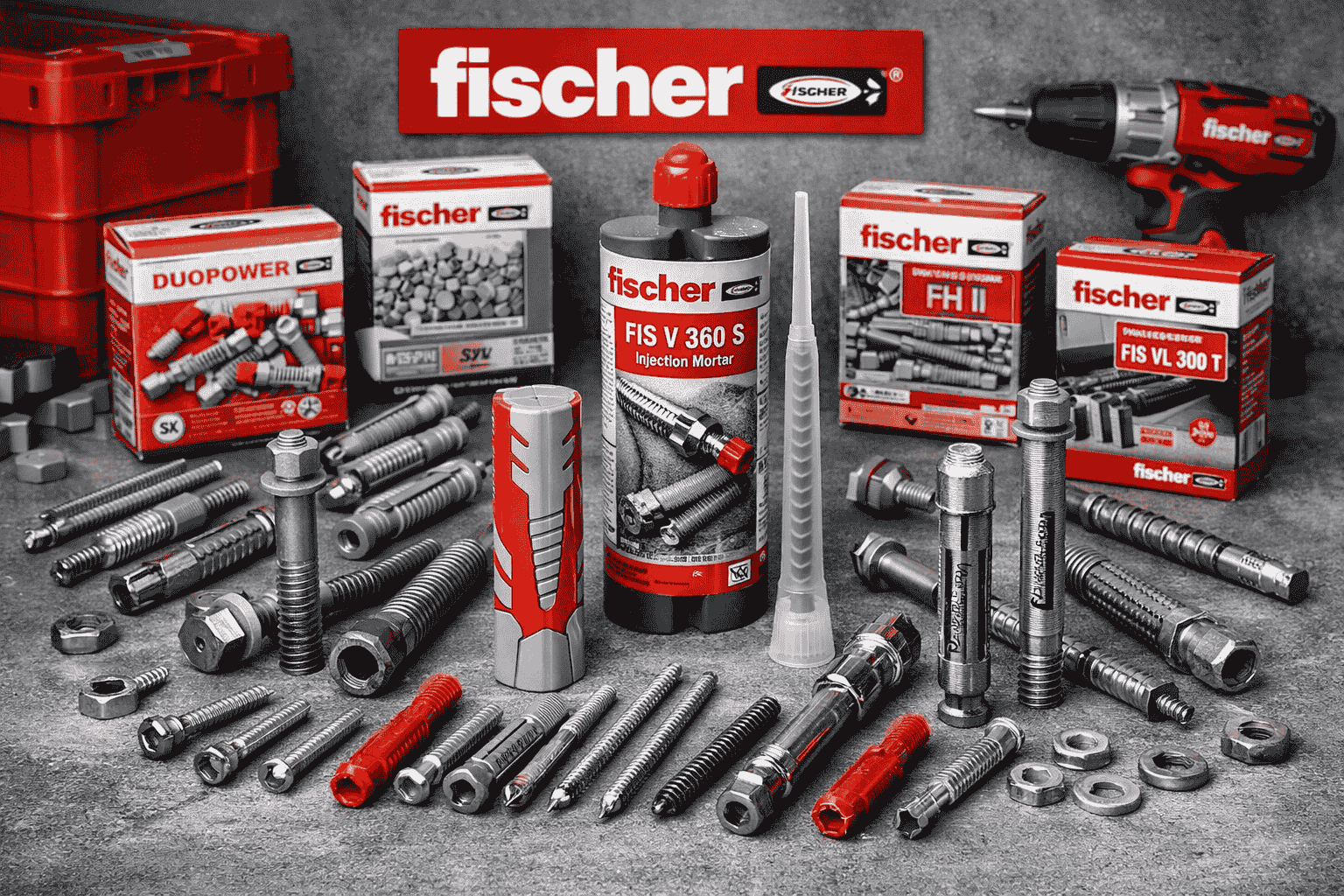
The Strength You Do Not See Often Matters the Most
Walk into any commercial tower, factory, hospital, or solar plant and you will notice concrete, steel, glass, and technology. What you will not notice are the anchoring points quietly holding everything in place.
Yet those hidden connections decide whether a structure performs for decades or begins to weaken under stress.
India continues to expand infrastructure, renewable energy projects, and industrial facilities. More than 58 percent of the country falls under moderate to severe seismic zones according to the Bureau of Indian Standards IS 1893. That reality changes how we must think about structural reliability.
The real question becomes simple. Are the fixing systems beneath your structure engineered for long term safety, or selected only for short term cost?
That is where Fischer fasteners and engineered structural fixing solutions enter the conversation.
Structural Integrity Begins at the Anchor Point
Every structure transfers load. Steel transfers weight to the concrete. Façades transfer wind pressure to the frames. Machinery transfers vibration into the foundations.
Fasteners control how those loads move.
High-performance Fischer fixing systems are designed to manage tensile forces, shear forces, edge distances, cracked concrete conditions and dynamic stress. They do not merely connect materials. They distribute force safely.
Now consider this. Many structural failures do not start with beams or columns. They begin with weak connections. Research published by the Institution of Structural Engineers highlights that connection design and installation errors contribute significantly to localised structural failures. A small anchor failure can trigger progressive damage.
When you choose certified industrial fasteners’ India suppliers who provide tested load data, you reduce that risk from the start.
Imagine a high rise façade facing wind speeds above 150 to 200 km per hour. Façade engineering studies referenced by CTBUH indicate that anchoring systems must sustain such pressures consistently. The anchor is not an accessory. It is a structural component.
So ask yourself. If the connection fails, what follows next?
That is why engineered structural fixing solutions deserve attention at the design stage, not after installation.
Certification Transforms Hardware into Engineering
Standards exist for a reason. They remove guesswork.
Certified Fischer fasteners undergo load testing, fire resistance validation and corrosion performance checks under strict global guidelines. European Technical Assessments and other international certifications evaluate how anchors behave in cracked concrete, seismic zones and under fire exposure.
This matters more than many assume.
The National Fire Protection Association reports that structural failures during fire events often relate to compromised load-bearing connections. Under extreme heat, poorly selected anchors can lose their capacity. Fire-rated fischer fixing systems maintain structural integrity longer, which directly supports passive fire protection systems and evacuation safety.
Certification does not add paperwork. It adds predictability.
Consider applications such as suspended cable trays, fire sprinklers and heavy service installations. Each anchor must maintain holding power under normal and extreme conditions. When engineers rely on verified industrial fasteners from Indian suppliers, they gain access to technical load tables and performance data instead of assumptions.
Compliance builds confidence. And confidence protects projects long after handover.
Durability in Harsh Environments Defines Long Term Stability
India presents diverse environmental challenges. Coastal regions introduce salt exposure. Industrial zones expose structures to chemicals. Renewable energy projects operate under constant UV radiation and temperature variation.
Corrosion quietly weakens structures year after year.
According to NACE International, now AMPP, corrosion costs the global economy more than 2.5 trillion dollars annually. That equals roughly 3 to 4 percent of global GDP. A significant portion of that loss relates to infrastructure degradation.
The anchor you choose influences how quickly corrosion advances.
High grade stainless steel anchors and chemical anchoring systems within Fischer fixing systems offer strong resistance against moisture and aggressive environments. This directly improves the service life of structural fixing solutions used in bridges, parking structures, and industrial plants.
Think about solar mounting systems. Solar projects operate for 25 years or more. Anchors support panels against wind uplift and vibration every single day. If corrosion reduces holding capacity, system alignment shifts and maintenance costs increase.
When durability aligns with engineering design, long term stability becomes achievable rather than hopeful.
The next question becomes even more critical. How does anchoring perform under dynamic movement?
Seismic and Dynamic Loads Demand Precision
Seismic forces do not behave like static loads. They introduce sudden movement, shifting stress patterns, and repeated cycles of tension and compression.
More than half of India lies in earthquake prone zones. That statistic alone demands better anchoring strategies.
Certain fischer fasteners carry seismic approvals under recognised performance categories. These anchors are tested in cracked concrete conditions that simulate real world seismic behaviour. They resist pull out forces and maintain integrity during tremors.
Industrial machinery presents a similar challenge. Heavy equipment generates vibration daily. Without properly selected structural fixing solutions, anchors loosen over time. This leads to misalignment, production disruption, and safety hazards.
Engineered fischer fixing systems address this by combining mechanical anchoring with chemical bonding technologies where required. That blend of design and material science improves stability in demanding applications.
Seismic and vibration performance is not an upgrade. It is a necessity in modern construction.
Once structural reliability and durability are addressed, procurement decisions become the final piece of the puzzle.
The Difference Between Buying a Product and Selecting a System
Fastener selection often happens late in the project cycle. Procurement teams compare price lists. Substitutions occur. Technical documents remain unread.
Yet anchoring decisions influence structural safety long after project completion.
Reliable industrial fasteners India suppliers provide more than inventory. They offer technical consultation, installation guidelines, and support tools that help engineers verify embedment depth, load capacity and edge conditions.
Consider five reflective questions before finalising a fastening choice.
Does the anchor match actual load calculations?
Has corrosion exposure been evaluated?
Is the substrate cracked or uncracked concrete?
Does the system hold a valid certification?
Will the anchor perform under fire or seismic stress?
Short term savings often result in long term repair costs. Downtime, retrofitting, and structural reinforcement exceed the initial price difference.
When you treat Fischer fasteners as engineered components rather than simple commodities, the conversation shifts from cost to lifecycle performance.
And lifecycle performance ultimately shapes reputation.
Practical Takeaways for Stronger Structural Decisions
Structural safety depends on informed decisions. The following actions strengthen outcomes across projects.
- Verify load ratings against real site conditions rather than catalogue assumptions.
- Select certified Fischer fixing systems for high risk structural applications.
- Avoid replacing tested structural fixing solutions with unverified alternatives.
- Prioritise corrosion-resistant materials for coastal or industrial environments.
- Confirm fire and seismic approvals where applicable.
- Consult detailed load tables and technical documentation before installation.
- Treat anchors as structural elements, not accessories.
Each step reduces uncertainty and improves reliability.
Long-Term Stability Is a Design Choice
Structures do not fail overnight. Weakness develops gradually. Corrosion spreads. Vibrations loosen anchors, and load paths shift. Eventually, visible damage appears.
By then, correction becomes expensive and complex.
The strength of a structure begins at its smallest connection point. Engineered fischer fasteners reinforce that foundation with tested performance, durability and compliance. Certified structural fixing solutions convert uncertainty into measurable safety.
Infrastructure in India continues to expand across cities, industrial corridors, and renewable energy landscapes. As projects scale in size and complexity, precision in fastening becomes even more important.
The real measure of quality is not how a structure performs on opening day. It is how it performs ten, twenty, or thirty years later.
When you evaluate your next project, pause and reflect. Are your anchors designed for long term stability, or simply installed to complete a checklist?
In modern construction, structural confidence begins where materials meet. And the right fixing system ensures that the connection remains strong long after the project leaves the drawing board.