
Fischer Chemical Anchors vs Mechanical Fasteners in Heavy Duty Applications
Mechanical Fasteners and Fischer chemical anchors is not only about installation preference. It directly influences load performance, long term stability and the durability of the entire system.
When One Small Fixing Carries the Weight of an Entire Structure
A steel bracket is installed on a concrete wall inside a manufacturing plant. The equipment attached to it weighs hundreds of kilograms. The installation looks simple. A hole is drilled, the anchor is placed, and the structure is tightened into position.
But the real question appears months later. Will that fixing hold steady when machines vibrate daily, and loads keep shifting constantly?
In modern construction and industrial projects, fastening systems quietly determine structural safety.
What appears to be a small component often carries enormous responsibility. The choice between Mechanical Fasteners and Fischer chemical anchors is not only about installation preference. It directly influences load performance, long term stability and the durability of the entire system.
As infrastructure projects expand and industrial installations become heavier, engineers and contractors are re-evaluating traditional fastening choices. In many situations, the difference between friction based anchors and bonded anchoring technology becomes critical.
Understanding how these systems behave under real working conditions helps professionals make better installation decisions. The discussion ahead explores how Mechanical Fasteners, Fischer chemical anchors and chemical anchor bolts India solutions compare in heavy-duty applications.
Why Anchoring Systems Matter in Modern Construction
Construction today carries loads that earlier structures rarely faced. Industrial equipment has grown heavier. Solar mounting systems span larger areas. Steel frameworks support complex machinery and infrastructure.
At the centre of all these installations lies a simple requirement. Every structural load must transfer safely to the base material.
Anchors play a vital role in this process. According to the American Concrete Institute building code, anchors are responsible for transferring loads between structural and non structural elements in concrete systems. When anchoring systems fail, the structure above them becomes vulnerable.
This explains why the choice between Mechanical Fasteners and Fischer chemical anchors matters more than ever. Both systems perform the same function. They secure components to concrete. Yet the way they achieve this strength differs significantly.
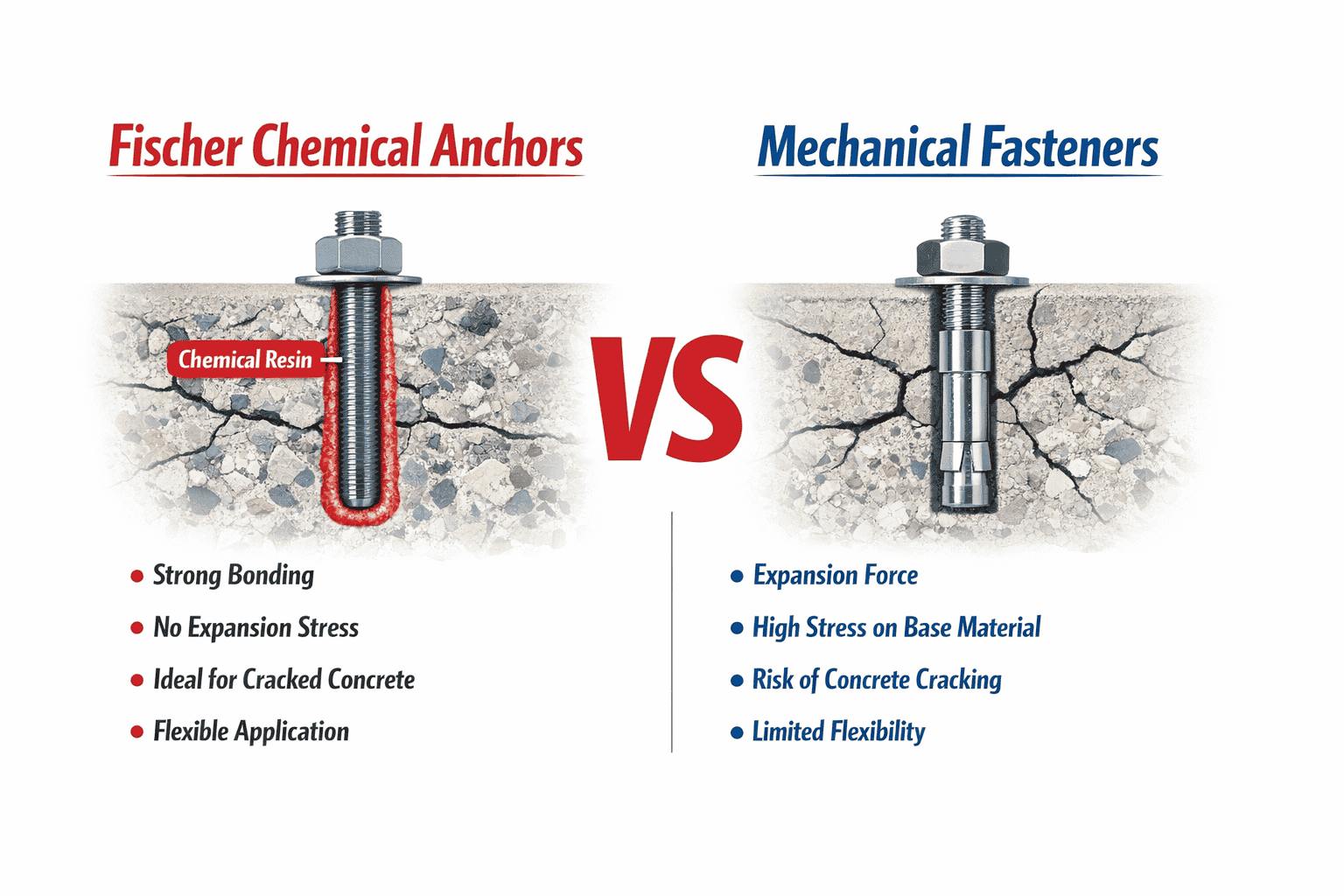
Mechanical Fasteners rely on expansion or mechanical locking to create friction inside the drilled hole. The pressure against the surrounding concrete creates holding power.
In contrast, Fischer chemical anchors rely on resin bonding. The anchor rod bonds chemically with the concrete surface. This process creates a strong adhesive connection rather than relying on expansion pressure.
The difference may appear small during installation. Under heavy loads, however, it can significantly affect performance.
Understanding How Mechanical Fasteners Hold Structural Loads
For decades, Mechanical Fasteners have been widely used across construction and industrial installations. Their popularity comes from simplicity and speed. Installation is straightforward and most anchors allow immediate load application.
These fasteners work through expansion or mechanical locking. Once inserted into the drilled hole, tightening the bolt forces an expansion element outward. This creates friction against the walls of the concrete hole, holding the anchor firmly in place.
Common types include wedge anchors, sleeve anchors and drop-in anchors. These solutions are reliable in many applications, particularly where installation speed matters.
However, expansion based anchors place stress on the surrounding concrete. The pressure that creates holding strength can also create localised stress around the hole.
Engineering studies from the European Organisation for Technical Assessment show that expansion anchors concentrate load near the expansion zone. When the surrounding concrete is strong and uncracked, this system works well.
The situation changes when concrete develops cracks or when anchors are installed close to edges.
In such cases, expansion pressure may reduce the strength of the surrounding material.
This is where many engineers begin considering Fischer chemical anchors instead of conventional Mechanical Fasteners.
How Fischer Chemical Anchors Create High Strength Bonds
Bonded anchoring technology approaches the problem differently. Instead of relying on expansion pressure, Fischer chemical anchors create strength through adhesive bonding.
The process begins by drilling a hole into the concrete base material. A specially formulated resin is then injected into the hole. After that, a threaded rod or reinforcement bar is inserted into the resin-filled space.
As the resin cures, it bonds with both the steel rod and the concrete surface. The result is a secure anchor that transfers load along the entire embedment depth.
This method distributes stress more evenly inside the concrete.
According to guidance from the American Concrete Institute standard ACI 355.4, bonded anchors often maintain higher load capacity in cracked concrete conditions compared to many expansion anchors.
The absence of expansion pressure also allows anchors to be installed closer to edges without damaging the surrounding concrete.
For structural engineers, this characteristic becomes valuable in complex installations where space is limited.
This explains why chemical anchor bolts in Indian systems have become common in infrastructure and industrial projects that require dependable load transfer.
Comparing Performance in Heavy Duty Applications
The real difference between Mechanical Fasteners and Fischer chemical anchors appears when installations face demanding working conditions.
Heavy equipment installations often involve vibration, dynamic loads, and temperature variation. Over time, these factors influence how anchors behave inside concrete.
Mechanical anchors that rely on friction may gradually loosen when exposed to continuous vibration. Bonded anchors maintain a stronger grip because the adhesive bond holds the rod securely along its entire length.
Load distribution also plays a role. When a mechanical anchor expands, stress concentrates around the expansion zone. Bonded anchors distribute the load more evenly along the hole.
This difference becomes particularly important in cracked concrete.
Research from the American Concrete Institute shows that cracked concrete significantly affects expansion anchors, while bonded systems maintain more consistent load capacity.
These performance characteristics explain why chemical anchor bolts India installations are often used in structural retrofitting and infrastructure reinforcement.
For example bridge repair projects frequently rely on bonded anchors to attach steel reinforcement plates to existing concrete structures. The adhesive bond ensures consistent load transfer even when the concrete contains microcracks.
Similarly, heavy machinery installations inside manufacturing facilities often rely on Fischer chemical anchors to maintain stability during vibration.
The goal is simple. The anchor should remain secure for years without losing strength.
Choosing the Right Anchoring Solution for Each Project
With two reliable technologies available, the question becomes practical rather than theoretical.
Which anchoring system should be used for a particular installation?
Several factors help guide this decision.
The first factor is load requirement. Projects involving heavy structural loads often benefit from bonded anchoring systems because of their higher load capacity.
The second factor is the concrete condition. If the base material is cracked or exposed to stress changes, Fischer chemical anchors may perform better than expansion-based Mechanical Fasteners.
The third factor involves edge distance and spacing. Expansion anchors require larger spacing between anchors to prevent cracking. Bonded anchors allow more flexibility in installation layout.
Installation conditions also matter. Mechanical Fasteners offer faster installation when speed is the priority. Bonded anchors require curing time, although modern resin technologies have reduced this delay significantly.
Infrastructure development across India continues to expand rapidly. Government reports on the National Infrastructure Pipeline indicate planned investments exceeding 1.4 trillion dollars in infrastructure development. Such projects require dependable fastening systems that maintain structural safety for decades.
As construction complexity increases, chemical anchor bolt installations in India are becoming more common in bridge reinforcement, steel structure anchoring, and renewable energy mounting systems.
These decisions ultimately shape how safely structures perform over time.
Practical Lessons for Engineers and Contractors
When evaluating fastening systems for heavy duty installations, a few practical observations help simplify the decision process.
Projects with moderate loads and solid concrete conditions often perform well with Mechanical Fasteners.
High load installations, cracked concrete environments or vibration-intensive machinery setups frequently benefit from Fischer chemical anchors.
Proper installation also plays a critical role. Technical guidance from anchor evaluation reports indicates that poor hole cleaning during installation can significantly reduce the load capacity of bonded anchors.
In other words, even the best technology depends on correct installation practices.
Understanding both the strengths and limitations of anchoring systems allows engineers to match the solution to the structural requirement rather than relying on habit.
The Quiet Role of Anchors in Structural Safety
Anchors rarely receive attention in project discussions. Steel structures, machines, and equipment dominate visual focus. Yet these components rely entirely on the strength of the anchoring system beneath them.
The comparison between Mechanical Fasteners and Fischer chemical anchors highlights an important reality in construction. Small decisions often influence large outcomes.
Both fastening technologies continue to serve important roles in heavy-duty installations. Mechanical anchors offer speed and convenience in many everyday applications. Bonded anchors provide stronger load distribution and improved performance in demanding structural conditions.
The real value lies in choosing the right system for the right situation.
As infrastructure projects grow larger and structural demands increase, fastening systems will continue to evolve. Engineers and contractors who understand the behaviour of anchoring systems today will be better prepared for the challenges of tomorrow.
Because when a structure depends on a single anchor point, the strength of that small component quietly supports everything above it.
And that leads to a simple but important question.
When heavy loads rely on hidden components, are we choosing the fastening system that truly carries the weight?