Digital Content Creation Market Size Forecast by Component, Deployment & Region Trends
The global digital content creation market is set for robust growth through 2030, driven by the increasing adoption of AI, cloud computing, and IT investments.
The global digital content creation market was valued at USD 32.28 billion in 2024 and is projected to reach USD 69.80 billion by 2030, growing at a CAGR of 13.9% from 2025 to 2030. Growth is being driven by the increased adoption of AI, rising IT investments, and widespread use of cloud computing.
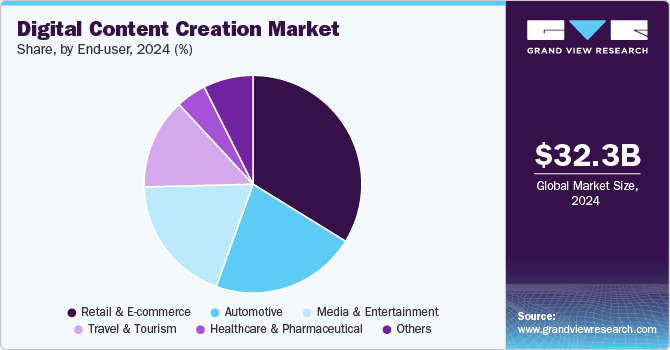
Digital content creation encompasses the development of content across multiple formats, including textual, graphical, audio, and video, followed by publishing or promoting it on digital platforms. Leading market players offer their services through both cloud-based and on-premises applications. For example, Integra Software Services provides its cloud platform iRights, which streamlines media rights acquisition, photo research, and text permissions workflows for publishers. Similarly, Figma, a cloud-based design tool, allows users to access design files from any device, leveraging vector technology for UI/UX design, wireframes, prototypes, and production-ready assets.
Key Market Trends & Insights
- North America dominated the market with a 33.4% share in 2024, led by the U.S. market.
- By component, the tools segment accounted for the largest revenue share of 73.1% in 2024.
- By content format, video emerged as the most dominant segment in terms of revenue.
- By deployment type, the cloud segment held the highest revenue share in 2024.
Download a free sample PDF of the Digital Content Creation Market Intelligence Study by Grand View Research.
Market Size & Forecast
- 2024 Market Size: USD 32.28 Billion
- 2030 Projected Market Size: USD 69.80 Billion
- CAGR (2025–2030): 13.9%
- Largest Regional Market (2024): North America
Competitive Landscape
The market is highly competitive, with major global players focusing on product innovation, strategic collaborations, and service expansions.
Key Players and Their Contributions
- Microsoft Corporation: Offers productivity tools like Microsoft 365 (Word, Excel, PowerPoint), collaboration platforms (Teams, SharePoint), and cloud solutions via Azure, enabling scalable AI-driven content creation and seamless team collaboration.
- Google LLC: Provides cloud computing, AI-powered tools, advertising technologies, software, and hardware solutions, supporting content creation and digital workflow optimization.
- Other notable companies: Picsart, Adobe Systems, Corel Corporation, Acrolinx, Integra Software Services, MarketMuse, Inc., Quark Software Inc., Canva.
Explore Horizon Databook – the world’s most comprehensive market intelligence platform by Grand View Research.
Conclusion
The global digital content creation market is set for robust growth through 2030, driven by the increasing adoption of AI, cloud computing, and IT investments. The growing demand for efficient, collaborative, and high-quality content creation tools across text, graphics, audio, and video formats is fueling market expansion. North America currently leads the market, while cloud-based solutions and video content continue to dominate globally. Key players such as Microsoft, Google, Adobe, and Canva are leveraging innovations, strategic partnerships, and AI-driven platforms to enhance content creation capabilities, improve workflow efficiency, and meet the evolving demands of businesses and creators, positioning the market for sustained growth and significant opportunities in the coming years.