Carbon Fiber Market (2025 – 2030) Trends in PAN, Pitch, Small & Large Tow
The carbon fiber market is poised for strong growth, fueled by expanding renewable energy investments, rising demand from aerospace and defense sectors, and increasing adoption in construction and infrastructure applications.
The global carbon fiber market was valued at approximately USD 5.75 billion in 2024 and is projected to reach USD 10.68 billion by 2030, expanding at a CAGR of 10.9% from 2025 to 2030. This robust growth is largely driven by the increasing adoption of carbon fiber in wind energy applications, supported by the global transition toward renewable energy sources.
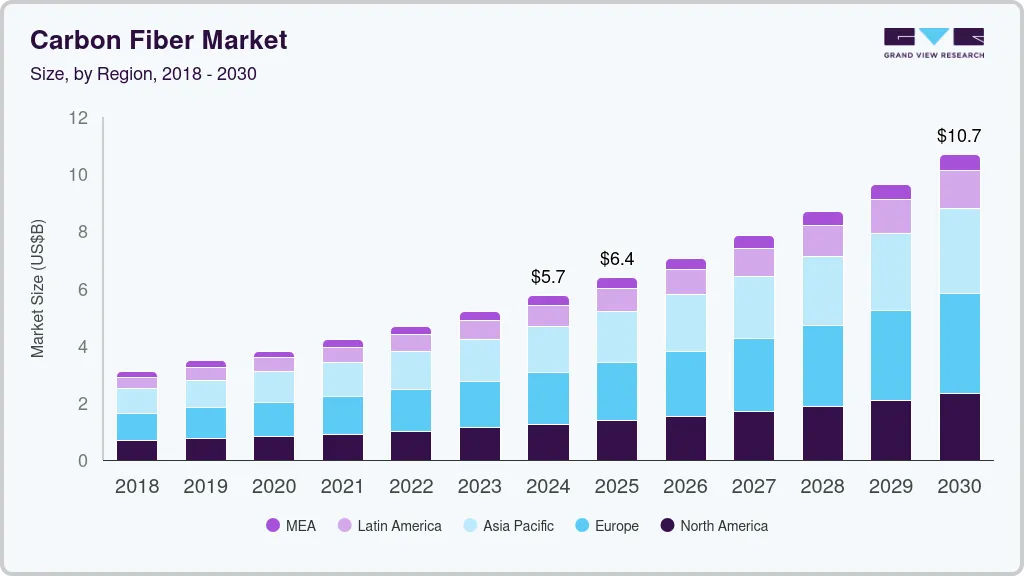
As countries strive to reduce reliance on fossil fuels, investments in wind energy infrastructure continue to rise. Carbon fiber’s exceptional strength-to-weight ratio, durability, and fatigue resistance make it an ideal material for wind turbine blades. Its use enables the production of longer and lighter blades, which capture more wind energy and significantly improve turbine efficiency and overall wind farm performance.
Beyond renewable energy, the construction and infrastructure sectors are increasingly recognizing carbon fiber’s advantages in enhancing structural performance. In civil engineering applications, carbon fiber is widely used for strengthening, retrofitting, and rehabilitating bridges, buildings, and other infrastructure assets. Its corrosion resistance, lightweight nature, and long service life provide clear benefits over traditional materials, particularly in harsh environments.
Key Market Trends & Insights
- Europe dominated the global carbon fiber market, accounting for 31.9% of total revenue in 2024.
- By raw material, the polyacrylonitrile (PAN) segment held the largest and fastest-growing share, representing 96.4% of revenue in 2024.
- By application, the aerospace & defense segment led the market with a revenue share of 32.2% in 2024.
- By tow size, the small tow segment dominated, accounting for 77.9% of total revenue in 2024.
Download a free sample PDF of the Carbon Fiber Market Intelligence Study by Grand View Research.
Market Size & Forecast
- Market Size (2024): USD 5.75 Billion
- Projected Market Size (2030): USD 10.68 Billion
- CAGR (2025–2030): 10.9%
- Largest Regional Market: Europe (2024)
Competitive Landscape
The carbon fiber market features a mix of established global manufacturers and emerging regional players. Major companies operating in the industry include Owens Corning, Rockwell International, A&P Technology Inc., and Anshan Sinocarb Carbon Fiber Co. Ltd, among others. These companies focus on capacity expansion, technological innovation, and strategic partnerships to strengthen their market presence.
- Owens Corning provides a broad portfolio of high-performance materials, including FOAMULAR extruded polystyrene (XPS) insulation boards, known for moisture resistance, durability, and thermal efficiency. The company also offers Thermafiber mineral wool insulation solutions, delivering fire resistance and acoustic control for residential and commercial applications.
- Rockwell International is a notable participant in the carbon fiber market, specializing in advanced insulation solutions for commercial and industrial use. With an emphasis on energy efficiency, sustainability, and long-term performance, Rockwell’s product portfolio includes mineral wool insulation boards designed for thermal, acoustic, and fire-resistant applications across walls, roofs, floors, and HVAC systems. The company’s carbon fiber offerings meet stringent industry standards and support energy conservation initiatives.
Key Players Include:
- A&P Technology Inc.
- Anshan Sinocarb Carbon Fiber Co. Ltd
- DowAksa USA LLC
- Formosa Plastics Corporation
- Hexcel Corporation
- Holding company Composite
- Hyosung Advanced Materials
- Jiangsu Hengshen Co. Ltd
- Mitsubishi Chemical Corporation
- Nippon Graphite Fiber Co. Ltd
- SGL Carbon
Explore Horizon Databook – the world’s most comprehensive market intelligence platform by Grand View Research.
Conclusion
The carbon fiber market is poised for strong growth, fueled by expanding renewable energy investments, rising demand from aerospace and defense sectors, and increasing adoption in construction and infrastructure applications. As industries continue to prioritize lightweight, durable, and high-performance materials, carbon fiber is expected to play a critical role in supporting sustainability, efficiency, and long-term structural resilience across multiple end-use sectors.