Blockchain in Gaming Market: The Impact of NFTs on Gameplay
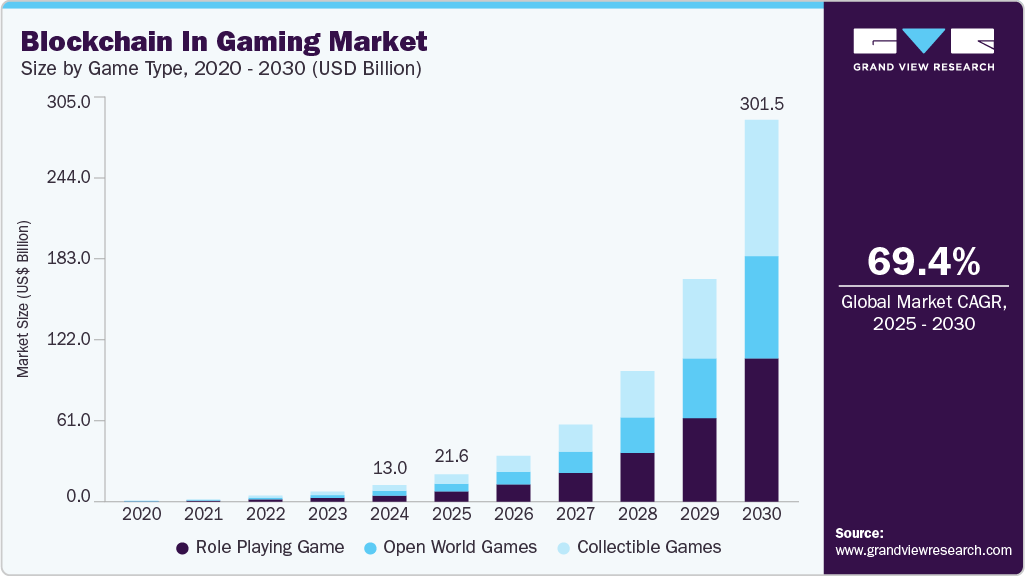
The global blockchain in gaming market was valued at USD 13.0 billion in 2024 and is forecast to reach USD 301.53 billion by 2030.
The global blockchain in gaming market was valued at USD 13.0 billion in 2024 and is forecast to reach USD 301.53 billion by 2030, expanding at a remarkable CAGR of 69.4% from 2025 to 2030. This rapid growth is largely driven by the increasing demand for a secure, transparent, and decentralized gaming ecosystem.
Blockchain technology functions as a decentralized and distributed digital ledger that ensures secure transactions and reliable recordkeeping. Its integration into the gaming industry has transformed the way developers and players interact with digital content, enabling the use of cryptocurrencies and non-fungible tokens (NFTs) for purchasing, trading, and owning in-game assets. For example, Axie Infinity is an NFT-based blockchain game with millions of players worldwide who conduct in-game transactions using Ethereum-based cryptocurrencies. By maintaining a public ledger of all transactions, blockchain enhances transparency within the gaming ecosystem, allowing players to verify asset ownership and track transfers. This structure ensures fair gameplay while enabling players to retain true ownership of their digital assets and conduct secure transactions without relying on intermediaries.
In recent years, the blockchain gaming sector has experienced a surge in investments and funding. This trend is supported by the growing adoption of blockchain technology, rising interest in decentralized gaming platforms, and the opportunity to deliver innovative gaming experiences along with new monetization models. Increased venture capital and institutional investments indicate rising market maturity and long-term confidence in blockchain gaming. Major gaming studios and technology companies are actively launching blockchain-based titles or investing in Web3 gaming startups, many of which are securing multi-million-dollar funding rounds, further accelerating market growth.
The integration of artificial intelligence (AI) and machine learning (ML) technologies has further strengthened blockchain gaming platforms. These technologies help identify and prevent fraudulent activities, such as bot usage and fake accounts. Additionally, AI and ML are used to analyze player behavior and preferences, enabling personalized gaming experiences through tailored game recommendations and in-game rewards. Game developers also leverage AI-driven insights from player data and feedback to refine game design and improve overall user engagement.
Order a free sample PDF of the Blockchain in Gaming Market Intelligence Study, published by Grand View Research.
Key Market Trends & Insights
- Regional Insights: Asia Pacific held the largest revenue share of 26.35% in 2024 and is expected to grow at a CAGR of 70.5% over the forecast period. This growth is driven by strong interest in cryptocurrencies, along with high internet and mobile penetration across the region. Increasing participation in digital asset markets has created a favorable environment for blockchain-based gaming platforms.
- Game Type Insights: The role-playing game (RPG) segment dominated the market in 2024, accounting for 37.1% of total revenue. RPGs offer immersive gameplay, detailed storylines, character development, and expansive virtual worlds, encouraging long-term player engagement and investment of time and resources.
- Platform Insights: The Ethereum (ETH) segment held the largest revenue share in 2024, supported by its advanced smart contract capabilities. These features allow developers to build decentralized applications (dApps), store in-game assets on the blockchain, and create decentralized marketplaces. Smart contracts also automate game rules, ensuring fairness and transparency in gameplay.
- Device Insights: The web-based segment led the market in 2024 due to its ease of access and user-friendly experience. Web-based blockchain games can be played directly through browsers without the need for downloads or installations, lowering technical barriers and encouraging broader adoption.
Market Size & Forecast
- 2024 Market Size: USD 13.0 Billion
- 2030 Projected Market Size: USD 301.53 Billion
- CAGR (2025-2030): 69.4%
- Asia Pacific: Largest market in 2024
Key Companies & Market Share Insights
Prominent companies operating in the blockchain gaming market include Animoca Brands Corporation Limited, Sky Mavis, and Dapper Labs, Inc. Blockchain game developers are increasingly creating interoperable gaming ecosystems, allowing players to use assets across multiple games and platforms. The rise of NFT marketplaces has further enabled players to buy, sell, and trade in-game assets, creating secondary markets and additional revenue streams for developers.
- Animoca Brands, headquartered in Hong Kong, is a leading player in blockchain gaming and digital entertainment, with operations across North America, Europe, Asia, Australia, and South America. The company has developed and invested in a wide range of Web3 projects, including The Sandbox, Moca Network, Anichess, Open Campus, GAMEE, TinyTap, Phantom Galaxies, and Crazy Defense Heroes.
- Sky Mavis, based in Singapore, specializes in decentralized applications and is best known for developing Axie Infinity, a blockchain-based game that enables players to own digital assets and earn rewards through gameplay.
Key Players
- Dapper Labs, Inc.
- Sky Mavis
- Splinterlands
- Animoca Brands Corporation Limited
- Immutable
- Uplandme, Inc.
- Illuvium
- Mythical Inc.
- ROKO GAME STUDIOS
- Autonomous Worlds Ltd.
Explore Horizon Databook – The world's most expansive market intelligence platform developed by Grand View Research.
Conclusion
The global blockchain in gaming market is set for exceptional growth through 2030, driven by increasing demand for decentralized, transparent, and player-owned gaming ecosystems. Advancements in blockchain technology, rising investments, integration of AI and ML, and growing interest in NFTs and cryptocurrencies are reshaping the gaming industry. While regulatory challenges persist, strong growth in Asia Pacific, expanding use of Ethereum-based platforms, and continuous innovation by leading companies position blockchain gaming as a transformative force in the future of interactive entertainment.