Biological Seed Treatment Market Development by Crop Type & Function
The biological seed treatment market is poised for strong growth, supported by sustainability-driven agricultural practices, rising health awareness, and advancements in microbial seed technologies.
The global biological seed treatment market was valued at approximately USD 1.60 billion in 2024 and is projected to reach USD 3.25 billion by 2030, expanding at a compound annual growth rate (CAGR) of 12.6% from 2025 to 2030. Market growth is primarily driven by the rising demand for chemical-free and sustainably produced crops. Increasing consumer awareness regarding personal health and a growing preference for healthier food choices are expected to further accelerate demand. Additionally, the expanding elderly population is likely to contribute to market growth, as food quality and safety become increasingly important.
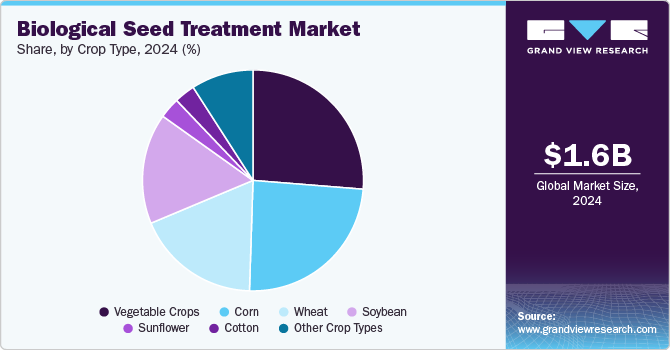
In the United States, corn represents the leading crop for biological seed treatment applications. Farmers are increasingly recognizing that appropriate biological seed treatments offer corn a strong advantage during early germination stages, supporting yield establishment and enhancing agricultural sustainability. When properly formulated with suitable microbial and fungal agents, biological seed treatments can significantly improve plant growth, delivering yield increases of up to 10%.
Key Market Trends & Insights
- North America led the global market, accounting for a 41.0% revenue share in 2024.
- By product type, the microbials segment held the largest share, representing 65.2% of total revenue in 2024.
- By crop type, vegetable crops emerged as the dominant segment, capturing over 26.4% of market revenue in 2024.
Download a free sample PDF of the Biological Seed Treatment Market Intelligence Study by Grand View Research.
Market Size & Forecast
- Market Size (2024): USD 1.60 Billion
- Projected Market Size (2030): USD 3.25 Billion
- CAGR (2025–2030): 12.6%
- Largest Regional Market: North America (2024)
Competitive Landscape
The biological seed treatment market is moderately consolidated, with several multinational players actively investing in research, innovation, and sustainable agricultural solutions. Key companies operating in this space include Bayer CropScience, BASF SE, and Italpollina S.p.A.
- Bayer CropScience, headquartered in Germany, is a global pharmaceutical and life sciences company with a strong presence in agricultural solutions. Its life science division develops biological pesticides and innovative agrochemicals. The company provides sustainable farming solutions worldwide, offering products such as herbicides, fungicides, insecticides, harvest aids, seed treatments, and plant growth regulators for crops including wheat, rice, corn, soy, peanuts, and grapes. Bayer operates across Europe, Asia Pacific, North America, Latin America, and the Middle East & Africa.
- Syngenta AG, based in Switzerland, was formed through the merger of Zeneca Agrochemicals and Novartis Agribusiness. The company operates 111 R&D centers and 100 production and supply facilities globally. Currently owned by ChemChina, Syngenta delivers bio-based seed treatment solutions such as biostimulants, biofungicides, and bionematicides, serving millions of farmers across more than 90 countries.
Key Players Include:
- Bayer CropScience
- Syngenta AG
- BASF SE
- Monsanto Company
- Italpollina S.p.A.
- Koppert Biological Systems
- Incotec
- Plant Health Care plc
- Precision Laboratories, LLC
- Verdesian Life Sciences
- Valent Biosciences LLC
Explore Horizon Databook – the world’s most comprehensive market intelligence platform by Grand View Research.
Conclusion
The biological seed treatment market is poised for strong growth, supported by sustainability-driven agricultural practices, rising health awareness, and advancements in microbial seed technologies. As regulatory pressure on chemical inputs intensifies and farmers increasingly seek eco-friendly yield-enhancing solutions, biological seed treatments are expected to play a critical role in the future of global agriculture.