
Australia Truck Market Projected to Reach USD 280.91 Million by 2033
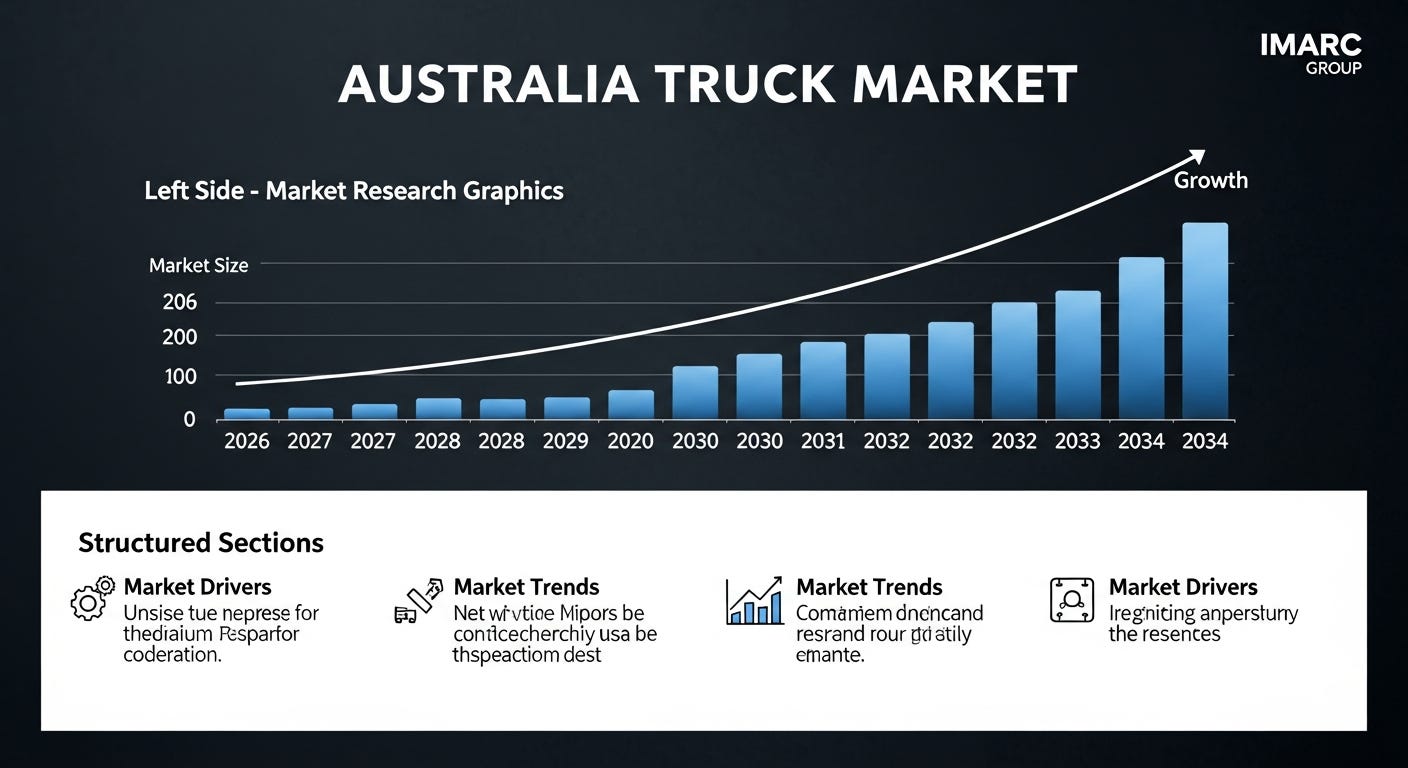
Australia truck market size reached USD 150.00 Million in 2024. Looking forward, the market is projected to reach USD 280.91 Million by 2033, exhibiting a growth rate (CAGR) of 7.22% during 2025-2033.
Market Overview
The Australia truck market size reached USD 150.00 Million in 2024 and is projected to reach USD 280.91 Million by 2033, growing at a CAGR of 7.22% during 2025-2033. The market is gaining steady momentum on the back of growing demand for freight and logistics services, rising focus on sustainability, government infrastructure investments, and technological advancements. Fleet operators are adopting cleaner, safer, and more efficient vehicles to meet regulatory standards, reduce costs, and align with shifting consumer and environmental expectations.
In 2024, around 114,000 new battery electric and plug-in hybrid vehicles were sold in Australia, up from 98,000 in 2023, reflecting the growing momentum toward electrification. In April 2025, Isuzu Australia Limited unveiled its all-new 2025 truck range at a major launch event in Melbourne, celebrating 36 years of market leadership with models reflecting extensive R&D tailored for Australian conditions. In March 2025, the first Australian-built Volvo FH16 780 XXL was produced at Volvo Group Australia’s Wacol facility, equipped with the most powerful engine in Australia, to be delivered to SRH Milk Haulage for transporting milk across NSW. With fleet operators seeking alternative energy trucks as part of their long-term plans to decrease environmental footprint and enhance operational stability, the Australia truck market is positioned for sustained, technology-driven expansion over the forecast horizon.
How AI is Reshaping the Future of the Australia Truck Market
Artificial intelligence is rapidly reshaping how Australian truck fleet operators optimize routes, predict maintenance needs, and enhance safety across heavy, medium, and light-duty vehicle segments. Key applications include:
- AI-powered telematics platforms analyzing driver behavior, vehicle performance, and real-time traffic data, enabling route optimization and fuel efficiency improvements for logistics fleets.
- Machine learning algorithms predicting component wear patterns for brakes, transmissions, and engines, enabling proactive maintenance and reducing unplanned downtime for long-haul heavy-duty trucks.
- AI-driven autonomous driving features including adaptive cruise control and lane-keeping assistance, reducing driver fatigue and improving safety for interstate freight operations.
- Intelligent fleet management systems coordinating platooning technologies where trucks move closely together, boosting fuel efficiency and lowering emissions for logistics applications.
- Computer vision systems automating warehouse loading and unloading operations, reducing turnaround times for light and medium-duty trucks serving e-commerce last-mile deliveries.
Australia Truck Market Trends
Rise of Electric and Zero-Emission Trucks
The Australia truck market outlook is undergoing a significant transformation as electric and zero-emission trucks become more prevalent. This shift is driven by increasing demand for cleaner transport solutions, with companies investing in electric vehicles (EVs) to meet both environmental targets and public expectations. In 2024, around 114,000 new battery electric and plug-in hybrid vehicles were sold in Australia, up from 98,000 in 2023, reflecting the growing momentum toward electrification. These trucks are quieter, use less fuel, and emit less, making them suitable for city deliveries as well as long-haul applications. Despite persistent challenges such as limited charging points, expensive initial outlays, and variability in policy by state, the transition towards sustainable transport marches on, as fleet operators seek alternative energy trucks as part of their long-term plans to decrease environmental footprint and enhance operational stability across the construction, logistics, and agriculture sectors.
Adoption of Advanced Safety and Telematics Technologies
Safety and efficiency are prime concerns in the contemporary Australia truck industry, leading to mass adoption of high-end safety systems and telematics devices. These systems enable fleets to monitor driver habits, track vehicle performance, and optimize routes in real time, hugely improving overall productivity. Safety functions like collision alerts, lane assistance, and driver fatigue detection are being fitted as standard on new truck models to minimize accidents and improve road safety, thus aiding the Australia truck market share. Notably, adaptive cruise control is now used by 44% of fleets, while autonomous emergency braking is adopted by 43%, highlighting growing industry reliance on automated safety functions. Telematics also plays a critical part in facilitating proactive maintenance, which reduces downtime and maximizes vehicle life. In March 2025, the first Australian-built Volvo FH16 780 XXL was produced at Volvo Group Australia’s Wacol facility, showcasing local manufacturing with advanced features like the new I-Shift transmission and Volvo Dynamic Steering, highlighting the importance of locally engineered trucks for uptime and productivity.
Request a Business Sample Report for Procurement & Investment Evaluation:
https://www.imarcgroup.com/australia-truck-market/requestsample
Australia Truck Market Summary
- Market Size in 2024: USD 150.00 Million, supported by growing demand for freight and logistics services and rising focus on sustainability.
- Forecast Value by 2033: USD 280.91 Million, driven by government infrastructure investments and technological advancements.
- CAGR (2025-2033): 7.22%, reflecting strong demand for cleaner, safer, and more efficient vehicles across heavy, medium, and light-duty segments.
- Leading Vehicle Type: Light Duty Truck, dominating due to e-commerce expansion and last-mile delivery requirements in urban and regional areas.
- Leading Fuel Type: Diesel, remaining dominant due to its fuel efficiency, reliability, and suitability for long-haul heavy-duty applications.
Australia Truck Market Growth Drivers
Expansion of E-commerce and Logistics
The swift growth of e-commerce in Australia has greatly heightened the necessity for effective and timely delivery services in both urban and rural areas. Online retailers, logistics firms, and courier services are bolstering their fleets to meet the rising consumer demands for same-day and next-day deliveries. This boom has especially increased the need for light and medium-duty trucks, which are well-suited for last-mile logistics. Additionally, the transportation of goods from warehouses to retail outlets has experienced growth, necessitating dependable commercial trucking solutions. As digital commerce continues to thrive, the demand for a responsive and scalable transport infrastructure becomes increasingly critical, directly impacting Australia truck market demand across the retail and logistics sectors. In April 2025, Isuzu Australia Limited unveiled its all-new 2025 truck range at a major launch event in Melbourne, coinciding with its annual National Dealer Business Meeting. Celebrating 36 years of market leadership, IAL highlighted the significance of new safety and emissions standards shaping the range, with models described as a “once in a generation” launch reflecting extensive R&D tailored for Australian conditions.
Infrastructure Projects Fueling Heavy-Duty Truck Utilization
Ongoing investments in infrastructure in Australia spanning highways, bridges, mining corridors, and urban transit systems are enhancing the demand for heavy-duty trucks. These vehicles are essential for transporting construction materials, machinery, and aggregates to and from construction sites. Major initiatives from both state and federal governments aimed at improving road connectivity and promoting economic growth have established a steady demand for tippers, haul trucks, and flatbeds. Furthermore, infrastructure enhancements in remote and resource-rich regions require long-haul transport capabilities, driving up demand. As these extensive developments progress, they present significant growth prospects for truck manufacturers and fleet operators across Australia. In March 2025, the first Australian-built Volvo FH16 780 XXL was produced at Volvo Group Australia’s Wacol facility, equipped with the most powerful engine in Australia, to be delivered to SRH Milk Haulage for transporting milk across NSW, with SRH’s Scott Harvey highlighting the importance of locally engineered trucks for uptime and productivity vital for their 24/7 operations.
Market Segments
By Vehicle Type:
- Heavy Duty Truck
- Medium Duty Truck
- Light Duty Truck
By Tonnage Capacity:
- 3.5 – 7.5 Tons
- 7.5 – 16 Tons
- 16 – 30 Tons
- Above 30 Tons
By Fuel Type:
- Diesel
- Petrol
- CNG & LNG
By Application:
- Construction
- Logistics
- Others
By Region:
- Australia Capital Territory & New South Wales
- Victoria & Tasmania
- Queensland
- Northern Territory & Southern Australia
- Western Australia
Competitive Landscape
The Australia truck market features participation from global truck manufacturers, domestic distributors, and specialized OEMs competing across vehicle types (heavy duty, medium duty, light duty), tonnage capacities, fuel types (diesel, petrol, CNG & LNG), and applications (construction, logistics). Key players include Daimler Truck Australia Pacific Pty Ltd, Hyundai Trucks Australia, Isuzu Australia Limited, Komatsu Australia Pty Ltd, PACCAR Australia, Scania Australia, and Volvo Trucks Australia. Market participants are pursuing product innovation through electric and zero-emission truck development, advanced safety systems (adaptive cruise control, autonomous emergency braking), telematics integration, and local manufacturing capabilities. In April 2025, Isuzu Australia Limited unveiled its all-new 2025 truck range at a major launch event in Melbourne, celebrating 36 years of market leadership with models reflecting extensive R&D tailored for Australian conditions and new safety and emissions standards. In March 2025, the first Australian-built Volvo FH16 780 XXL was produced at Volvo Group Australia’s Wacol facility, showcasing local manufacturing with advanced features like the new I-Shift transmission and Volvo Dynamic Steering, equipped with the most powerful engine in Australia. The competitive landscape is also shaped by the aging fleet replacement needs, with fleet operators replacing older trucks with newer, technologically advanced models to comply with changing regulations, reduce maintenance interruptions, and lower long-term operational expenses. As fleet modernization drives substantial demand, OEMs are releasing advanced models equipped with compliance-ready features across the heavy, medium, and light-duty truck segments.
Latest News & Developments
- April 2025: Isuzu Australia Limited unveiled its all-new 2025 truck range at a major launch event in Melbourne, coinciding with its annual National Dealer Business Meeting, celebrating 36 years of market leadership with models reflecting extensive R&D tailored for Australian conditions and new safety and emissions standards.
- March 2025: The first Australian-built Volvo FH16 780 XXL was produced at Volvo Group Australia’s Wacol facility, showcasing local manufacturing with advanced features like the new I-Shift transmission and Volvo Dynamic Steering, equipped with the most powerful engine in Australia, to be delivered to SRH Milk Haulage for transporting milk across NSW.
Note: If you require any specific information not currently covered within the scope of the report, IMARC Group will provide it as part of customization.
Speak to an analyst:
https://www.imarcgroup.com/request?type=report&id=32984&flag=E
About Us
IMARC Group is a global management consulting firm that helps the world’s most ambitious changemakers to create a lasting impact. The company provides a comprehensive suite of market entry and expansion services. IMARC offerings include thorough market assessment, feasibility studies, company incorporation assistance, factory setup support, regulatory approvals and licensing navigation, branding, marketing and sales strategies, competitive landscape and benchmarking analyses, pricing and cost research, and procurement research.
Contact Us
IMARC Group 134 N 4th St., Brooklyn, NY 11249, USA Email: sales@imarcgroup.com Tel. No.: (D) +91 120 433 0800