
Australia Industrial Automation Sensors Market Projected to Reach USD 1,024.1 Million by 2034
The Australia industrial automation sensors market size reached USD 494.8 Million in 2025. Looking forward, IMARC Group expects the market to reach USD 1,024.1 Million by 2034, exhibiting a growth rate (CAGR) of 8.16% during 2026-2034.
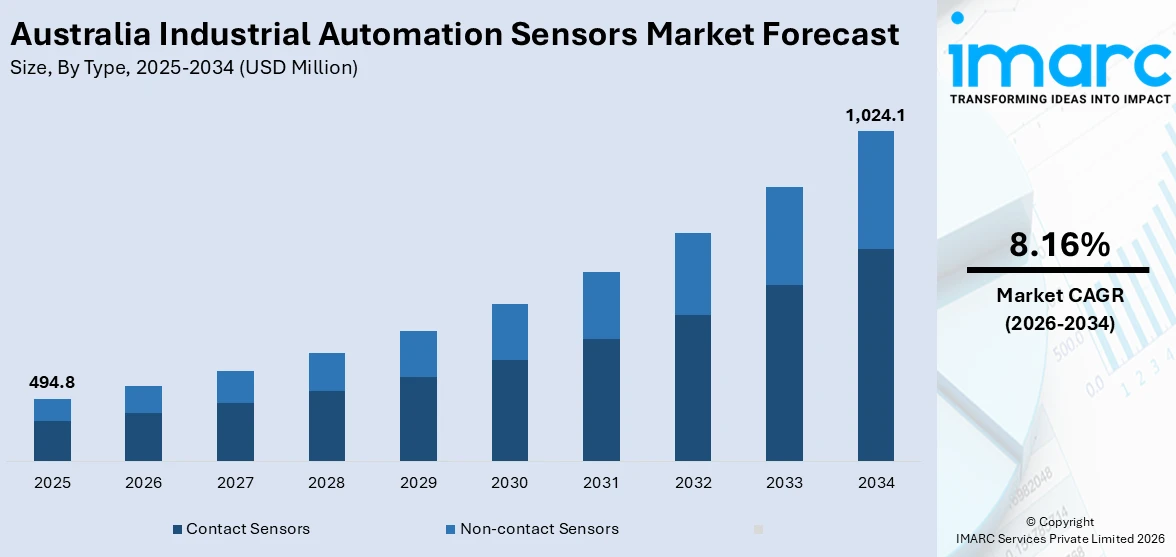 Australia Industrial Automation Sensors Market Overview
The Australia industrial automation sensors market is experiencing robust growth, driven by accelerating Industry 4.0 adoption, expanding smart manufacturing capabilities, and increasing deployment of IoT-enabled monitoring systems across key industrial sectors. According to the latest report by IMARC Group, titled "Australia Industrial Automation Sensors Market: Industry Trends, Share, Size, Growth, Opportunity and Forecast 2026-2034," the Australia industrial automation sensors market reached USD 494.8 Million in 2025. Looking forward, IMARC Group expects the market to reach USD 1,024.1 Million by 2034, exhibiting a growth rate (CAGR) of 8.16% during 2026-2034.
Australia's industrial automation sensors industry encompasses a comprehensive range of sensor technologies including image sensors, pressure sensors, temperature sensors, position sensors, humidity and moisture sensors, level sensors, flow sensors, gas sensors, and force sensors. These sensors operate across contact and non-contact configurations — with non-contact variants including photonic, hall effect, capacitive, ultrasonic, inductive, and laser displacement sensors — serving both semi-automatic and fully-automatic industrial systems. The market caters to a diverse array of end-use industries spanning oil and gas, automotive, food and beverage, semiconductor and electronics, chemicals and materials, consumer goods, mining and metals, pharmaceuticals and biotech, power, machines and tools, paper and pulp, and aerospace and defense sectors.
The Australian industrial automation sensors market is being propelled by several converging factors. The growing adoption of Industry 4.0 principles and smart manufacturing technologies is driving demand for sophisticated sensor systems capable of real-time data acquisition, process monitoring, and predictive maintenance across manufacturing facilities. Australia's mining and resource sectors are increasingly deploying connected sensors to monitor equipment performance, track environmental conditions, and optimize resource extraction processes, enhancing both operational efficiency and workplace safety. Government initiatives promoting smart industry practices are further accelerating adoption, while the expansion of Australia's IoT sensors ecosystem — projected to reach USD 12.9 billion by 2034 at a 38% CAGR — creates a powerful growth tailwind. The convergence of edge computing, AI-driven analytics, and sensor fusion technologies is enabling industrial operators to extract actionable insights from sensor data in real time, transforming passive monitoring into proactive decision-making systems.
Request for a sample copy of this report: https://www.imarcgroup.com/australia-industrial-automation-sensors-market/requestsample
How AI is Reshaping the Future of the Australia Industrial Automation Sensors Market
Artificial intelligence is fundamentally transforming the industrial automation sensors landscape in Australia, evolving sensors from standalone measurement devices into intelligent nodes within interconnected industrial ecosystems. AI-powered analytics platforms are enabling sensors to not only capture data but interpret, predict, and autonomously respond to changing conditions, driving unprecedented levels of operational efficiency and reliability across manufacturing, mining, and logistics operations.
• Predictive Maintenance Through Sensor Fusion: AI algorithms are aggregating and analyzing data streams from multiple sensor types — vibration, temperature, pressure, and acoustic — to predict equipment failures before they occur. Australian mining and manufacturing operators are deploying these sensor fusion platforms to reduce unplanned downtime by up to 40% and extend equipment operational life by 15-30%, transforming maintenance from time-based schedules to condition-based interventions driven by real-time sensor intelligence.
• Edge AI for Real-Time Decision-Making: Edge computing integrated with AI is enabling sensors to process and analyze data locally at the point of capture, eliminating latency associated with cloud-based processing. This capability is critical for time-sensitive industrial applications where millisecond response times are required — such as quality inspection on high-speed production lines or safety shutdowns in hazardous environments. Australian manufacturers are increasingly deploying edge AI sensor systems that make autonomous decisions without human intervention.
• AI-Powered Image Sensing and Quality Control: Machine vision systems powered by deep learning are revolutionizing quality inspection across Australian manufacturing lines. AI-enhanced image sensors can detect microscopic defects, dimensional variations, and assembly errors at speeds far exceeding human inspection capabilities. These systems continuously learn from production data, improving detection accuracy over time and adapting to new product variants without manual reprogramming.
• Industrial Copilot Integration: Schneider Electric's development of an industrial copilot with Microsoft, integrating Azure AI Foundry with advanced industrial automation solutions, represents the next frontier of AI-sensor convergence. These AI copilots interpret sensor data through natural language interfaces, enabling operators to query equipment status, diagnose issues, and optimize processes through conversational interactions rather than complex monitoring dashboards.
• Digital Twin Technology for Process Optimization: AI-driven digital twin platforms are creating virtual replicas of industrial processes fed by real-time sensor data. Australian industries are adopting these technologies to simulate production scenarios, optimize energy consumption, and test process changes in a virtual environment before implementing them physically. Sensor networks provide the continuous data streams that keep digital twins accurate and responsive, enabling predictive simulation of equipment behavior and process outcomes.
Australia Industrial Automation Sensors Market Trends
Growing Adoption of IoT-Connected Sensor Networks Across Industries
The proliferation of IoT-connected sensor networks is a defining trend transforming Australia's industrial automation landscape. Manufacturing, agriculture, healthcare, and logistics sectors are deploying sensor-based monitoring systems at accelerating rates, creating interconnected ecosystems where sensor data flows seamlessly between operational technology (OT) and information technology (IT) environments. Australia's broader IoT sensors market — projected to grow from USD 708.1 million in 2025 to USD 12.9 billion by 2034 at a 38% CAGR — is providing a powerful technology ecosystem that amplifies demand for industrial-grade sensors. The deployment of 5G networks across Australian industrial corridors is further enabling this trend, providing the high-bandwidth, low-latency connectivity required for massive-scale sensor deployments in smart factories and remote mining operations. Industrial operators are expanding deployment of predictive maintenance solutions using IIoT sensors and analytics, with mining and resource companies using connected sensors to monitor equipment performance, track environmental conditions, and optimize extraction processes in real time.
Shift Toward Non-Contact and Advanced Sensing Technologies
The Australian industrial automation sensors market is witnessing a pronounced shift toward non-contact sensing technologies, driven by demands for higher precision, longer operational life, and compatibility with harsh industrial environments. Non-contact sensor variants — including photonic sensors, hall effect sensors, capacitive sensors, ultrasonic sensors, inductive sensors, and laser displacement sensors — offer advantages in applications where physical contact could damage sensitive materials, contaminate processes, or limit measurement speed. This trend is particularly strong in the food and beverage, pharmaceutical, and semiconductor sectors where contamination-free sensing is essential for maintaining product quality and regulatory compliance. Laser displacement sensors and ultrasonic sensors are gaining rapid traction in precision manufacturing applications, while capacitive and inductive sensors are increasingly preferred for position sensing in automated assembly lines. The growing sophistication of non-contact sensing technologies, combined with falling costs and improved miniaturization, is broadening their adoption from premium applications to mainstream industrial use across Australian manufacturing facilities.
Australia Industrial Automation Sensors Market Summary
• Market Size (2025): USD 494.8 Million
• Market Forecast (2034): USD 1,024.1 Million
• Growth Rate (CAGR 2026-2034): 8.16%
• Key Segments: By Sensor Type (Image Sensors, Pressure Sensors, Temperature Sensors, Position Sensors, Humidity & Moisture Sensors, Level Sensors, Flow Sensors, Gas Sensors, Force Sensors, Others), By Type (Contact Sensors, Non-contact Sensors), By Mode of Automation (Semi-Automatic Systems, Fully-Automatic Systems)
• Key End Users: Oil and Gas, Automotive, Food and Beverage, Semiconductor and Electronics, Chemicals and Materials, Consumer Goods, Mining and Metals, Pharmaceuticals and Biotech, Power, Machines and Tools, Paper and Pulp, Aerospace and Defense, Others
Australia Industrial Automation Sensors Market Growth Drivers
Mining and Resources Sector Driving Heavy-Duty Sensor Deployment
Australia's mining and metals sector represents a critical growth driver for industrial automation sensors, with operators across iron ore, coal, lithium, and critical minerals operations deploying increasingly sophisticated sensor networks to enhance safety, productivity, and environmental compliance. Connected sensors monitor equipment vibration, temperature, and wear conditions across vast conveyor networks, processing plants, and heavy mobile equipment, enabling predictive maintenance that reduces costly unplanned shutdowns. Gas sensors and environmental monitoring systems are essential for ensuring workplace safety in underground operations, while position sensors and image sensors support autonomous haul truck and drill operations being deployed across the Pilbara, Bowen Basin, and other major mining regions. The ongoing pipeline of critical minerals projects — supporting the global energy transition — is creating additional demand for purpose-built sensor solutions capable of operating in extreme temperatures, dust, and humidity conditions.
Smart Manufacturing and Government Industry 4.0 Initiatives
Government initiatives promoting smart industry practices and digital manufacturing transformation are accelerating sensor adoption across Australian manufacturing and processing sectors. The Australian government's support for advanced manufacturing capabilities — including funding programs for Industry 4.0 implementation, robotics integration, and digital skills development — is encouraging businesses to invest in comprehensive sensor networks as the foundation of smart factory architectures. The automotive, food and beverage, and pharmaceutical sectors are leading adoption of fully-automatic sensor systems that enable closed-loop process control, real-time quality monitoring, and regulatory compliance documentation. The convergence of sensor automation with robotics and digital twin technologies is creating demand for higher-density sensor deployments, as each automated cell and robotic workstation requires multiple sensor types for positioning, safety, quality inspection, and process control functions.
Australia Industrial Automation Sensors Market Segments
The Australia industrial automation sensors market can be segmented across multiple dimensions. By sensor type, the market includes image sensors, pressure sensors, temperature sensors, position sensors, humidity and moisture sensors, level sensors, flow sensors, gas sensors, force sensors, and others, each serving specific measurement and monitoring requirements across industrial processes. By type, the market divides into contact sensors and non-contact sensors, with non-contact variants encompassing photonic, hall effect, capacitive, ultrasonic, inductive, and laser displacement sensor technologies. By mode of automation, the market serves semi-automatic and fully-automatic systems, with fully-automatic configurations driving premium sensor demand. By end user, the market spans twelve major industrial sectors. By region, the market covers Australia Capital Territory & New South Wales, Victoria & Tasmania, Queensland, Northern Territory & Southern Australia, and Western Australia.
Breakup by Sensor Type:
• Image Sensors
• Pressure Sensors
• Temperature Sensors
• Position Sensors
• Humidity & Moisture Sensors
• Level Sensors
• Flow Sensors
• Gas Sensors
• Force Sensors
• Others
Breakup by Type:
• Contact Sensors
• Non-contact Sensors (Photonic, Hall Effect, Capacitive, Ultrasonic, Inductive, Laser Displacement)
Breakup by Mode of Automation:
• Semi-Automatic Systems
• Fully-Automatic Systems
Breakup by End User:
• Oil and Gas
• Automotive
• Food and Beverage
• Semiconductor and Electronics
• Chemicals and Materials
• Consumer Goods
• Mining and Metals
• Pharmaceuticals and Biotech
• Power
• Machines and Tools
• Paper and Pulp
• Aerospace and Defense
• Others
Breakup by Region:
• Australia Capital Territory & New South Wales
• Victoria & Tasmania
• Queensland
• Northern Territory & Southern Australia
• Western Australia
Australia Industrial Automation Sensors Market Competitive Landscape
The competitive landscape of the Australia industrial automation sensors market features a combination of global automation leaders and specialized domestic providers. Key players in the market include Schneider Electric, Motion Solutions Australia, Pacific Automation, Microsonic, Telstra Purple, Aeva, and Sensys Gatso Australia. Schneider Electric leads the market through its comprehensive industrial automation and control portfolio, with its Q1 2026 Industrial Automation segment generating €2 billion in quarterly revenue with 4.4% organic growth. The company's development of an industrial copilot with Microsoft — integrating Azure AI Foundry with advanced automation solutions — positions it at the forefront of AI-sensor convergence. Telstra Purple provides IoT connectivity and analytics platforms that enable sensor data aggregation and insights across industrial operations, while domestic players like Pacific Automation and Motion Solutions Australia offer localized engineering support and specialized sensor solutions tailored to Australian industry requirements.
Australia Industrial Automation Sensors Market Latest News and Development
• Q1 2026: Schneider Electric reported 11% organic growth with quarterly revenues reaching €10 billion, driven by strong performance in energy management and industrial automation segments. The company's AI strategy continues to advance, including its industrial copilot developed with Microsoft integrating Azure AI Foundry with advanced automation solutions.
• April 2026: Microsoft showcased industrial intelligence solutions at Hannover Messe 2026, demonstrating advanced AI-sensor integration platforms that enable Australian manufacturers to deploy intelligent automation systems connecting sensor data with predictive analytics and autonomous decision-making capabilities.
• May 2025: Schneider Electric unveiled innovations advancing manufacturing at Automate 2025, featuring a digital factory campus demonstrating advanced robotics, next-generation motion control, and open software-defined automation platforms that integrate with comprehensive industrial sensor networks.
• 2025: Australia's industrial IoT market reached USD 9.1 billion, with manufacturing, mining, agriculture, and logistics sectors accelerating deployment of sensor-based monitoring systems. Key trends include increased adoption of smart sensors, edge computing, and AI-driven analytics for remote monitoring and predictive maintenance.
• 2025-2026: The global industrial machinery components and sensors market reached USD 420.2 billion in 2025, with growth driven by smart manufacturing adoption, robotics integration, and digital twin technologies — all requiring dense sensor deployments that are accelerating demand across Australian industrial facilities.
Note: If you require any specific information not currently covered within the scope of the report, IMARC Group will provide it as part of customization.
Speak to an analyst:
https://www.imarcgroup.com/request?type=report&id=34238&flag=E
𝗔𝗯𝗼𝘂𝘁 𝗨𝘀
IMARC Group is a global management consulting firm that helps companies in strategy, operations, technology, and innovation. We have a strong track record of providing comprehensive market research reports and advisory services to a broad range of clients, including Fortune 500 companies, governments, and startups. Our reports cover over 3,000 markets across various industry verticals, providing in-depth analysis and insights on market size, share, growth, trends, and forecasts.
𝗖𝗼𝗻𝘁𝗮𝗰𝘁 𝗨𝘀
IMARC Group
134 N 4th St. Brooklyn, NY 11249, USA
Email: sales@imarcgroup.com
Tel No: (D) +91 120 433 0800
United States: +1-631-791-1145