
Australia Freeze-Drying Equipment Market Size, Share, Trends and Forecast 2026–2034
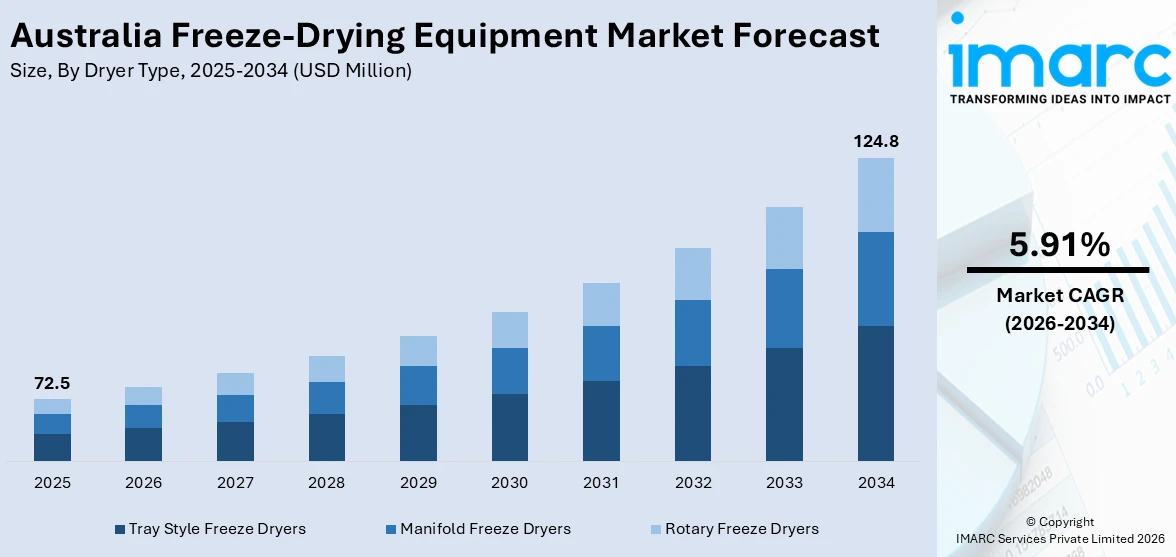
The Australia freeze-drying equipment market reached USD 72.5 million in 2025 and is projected to hit USD 124.8 million by 2034, growing at a CAGR of 5.91%.
Market Overview
The Australia freeze-drying equipment market reached USD 72.5 million in 2025 and is projected to hit USD 124.8 million by 2034, growing at a CAGR of 5.91%. Growth is driven by investments in advanced, sterile processing technologies, rising exports, expanding pharmaceutical applications, and a focus on domestic vaccine and drug manufacturing. Freeze-drying preserves heat-sensitive products by removing moisture under vacuum, ensuring quality and shelf life. Strong demand comes from pharmaceuticals, biotechnology, and rapidly growing food applications such as coffee, fruits, and ready meals. New South Wales and Victoria lead regionally, while South Australia emerges as an innovation hub today overall.
How AI is Reshaping the Future of the Australia Freeze-Drying Equipment Market
- Pfizer's AUD 150 million Melbourne biomanufacturing facility expansion — completed by mid-2025 and featuring two industrial lyophilisers for antimicrobial manufacturing — has been selected as a trial site for AI technology designed to support key site processes, with filling lines and lyophilization equipment relying heavily on automation and robotics-assisted aseptic packaging lines that represent the most advanced pharmaceutical manufacturing AI deployment in Australian freeze-drying operations.
- AI algorithms are being integrated into modern freeze-drying equipment to predict drying times based on material type and batch quantity, enabling precise control over temperature, pressure, and vacuum parameters throughout primary and secondary drying cycles — improving throughput, reducing energy consumption, and lowering defect rates across pharmaceutical and food processing applications in Australia.
- IoT-enabled smart freeze dryers equipped with real-time sensor networks are facilitating continuous monitoring of critical process parameters across Australian pharmaceutical manufacturing sites, ensuring compliance with TGA GMP standards and providing automated documentation and traceability data — critical for export-oriented pharmaceutical and food producers navigating multiple international regulatory frameworks simultaneously.
- AI-enabled predictive maintenance systems are being deployed in industrial-scale freeze dryers used in Australian pharmaceutical and biotechnology facilities, identifying potential equipment failures before they occur, reducing unplanned downtime during critical long-cycle lyophilization runs, and directly improving the overall equipment effectiveness of lyophiliser assets that represent multi-million-dollar capital investments.
- AI-based process optimization platforms are being applied to Australia's food freeze-drying operations — including freeze-dried fruit, vegetable, and specialty food export manufacturers in Queensland and New South Wales — using machine learning to optimize cycle parameters for different product formulations, reducing energy costs and improving color, texture, and nutritional retention outcomes that directly influence premium export product pricing and market access.
- Global freeze-drying equipment manufacturers serving the Australian market — including GEA Group, IMA Life, and Syntegon (which acquired Azbil Telstar in June 2025) — are integrating SCADA-equipped industrial units with real-time AI monitoring, automated loading and unloading robotics, and energy-efficient condenser designs aligned with Australian pharmaceutical manufacturers' sustainability reporting and TGA GMP compliance requirements.
Evaluate Market Potential Before You Invest – Get the Report Sample
https://www.imarcgroup.com/australia-freeze-drying-equipment-market/requestsample
Market Trends and Insights
Pfizer's Melbourne Lyophiliser Investment Elevating Industrial Pharmaceutical Standard: Pfizer's AUD 150 million Melbourne expansion with two industrial freeze-dryers targeting antimicrobial resistance treatment manufacturing — completed by mid-2025 with AI-assisted process monitoring and robotic packaging lines — is establishing a new benchmark for pharmaceutical-grade lyophilisation capability in Australia.
Sovereign Pharmaceutical Manufacturing Mandate Driving Domestic Lyophiliser Investment: Post-pandemic lessons around supply chain vulnerability have accelerated Australia's commitment to domestic pharmaceutical production capability, with lyophilised vaccine and biologic manufacturing identified as a strategic priority and ARENA and the National Reconstruction Fund directing investment toward sovereign biologics manufacturing that requires freeze-drying capacity.
Organic and Premium Food Export Markets Stimulating Food-Grade Equipment Demand: Australia's growing position as a premium food exporter — particularly for organic and clean-label freeze-dried coffee, fruits, berries, and health foods targeting Asian markets — is driving commercial food producers to invest in industrial freeze-drying capacity that preserves up to 97% of nutritional content and delivers superior flavor and texture compared with conventional drying alternatives.
New Entrants Emerging in Cannabis and Botanical Freeze-Drying: In February 2025, MedTEC Pharma in South Australia became one of the first Australian companies to manufacture freeze-dried products from locally grown plants, using a large-scale freeze dryer imported from New Zealand's Cuddon Freeze Dry to produce live rosin vapes, freeze-dried live flower, and live rosin gummies — signaling a new, fast-growing specialty application category for Australian freeze-drying equipment.
Automation and Energy Efficiency Reshaping Equipment Procurement Criteria: Australian buyers of industrial freeze-drying equipment are increasingly specifying automated loading and unloading systems, energy-efficient refrigeration, real-time process monitoring, and GMP-compliant digital documentation capabilities as standard procurement requirements — reflecting tightening TGA manufacturing standards, rising energy costs, and the growing complexity of pharmaceutical and food export compliance documentation.
Market Growth Drivers
Rising Pharmaceutical Industry Applications and Sovereign Manufacturing Investment
The Australian pharmaceutical industry's expanding investment in domestic biomanufacturing capability — driven by post-pandemic sovereign supply chain objectives, the National Reconstruction Fund's advanced manufacturing mandate, and the commercial requirements of globally operating pharmaceutical multinationals — is the primary structural driver of freeze-drying equipment demand in Australia. The pharmaceutical market's projected path toward USD 31.1 billion by 2033 encompasses expanding production of biologics, monoclonal antibodies, vaccines, injectable antimicrobials, and cell and gene therapy products — virtually all of which require lyophilisation at some stage of manufacturing or formulation. Pfizer's AUD 150 million Melbourne facility expansion — which added two industrial lyophilisers for antimicrobial production with AI-assisted process monitoring and robotic aseptic packaging — is the most concrete recent example of how global pharmaceutical capital investment directly translates into industrial freeze-drying equipment procurement in Australia. CSL's sustained investment in its Melbourne and Sydney biomanufacturing operations, CSIRO's biomedical research programs requiring laboratory and pilot-scale lyophilisers, and the growing pipeline of TGA-licensed contract development and manufacturing organizations are collectively sustaining a strong, recurring demand base for pharmaceutical-grade tray-style and industrial freeze-dryers across the Australian market.
Growing Demand for Premium Freeze-Dried Food and Nutraceutical Products
Australia's expanding premium food export sector — combined with rising domestic consumer demand for freeze-dried functional foods, health supplements, ready-to-eat meals, and outdoor adventure provisions — is creating a growing second demand pillar for food-grade freeze-drying equipment that is structurally distinct from but complementary to the pharmaceutical application driver. Freeze-drying retains up to 97% of nutritional content — substantially more than spray drying, heat drying, or dehydration alternatives — while preserving natural flavors, colors, and aromas without the use of preservatives, making it highly compatible with Australia's clean-label, organic, and premium food export positioning in Asian markets. The market for freeze-dried foods globally is expected to reach USD 1.5 billion by 2026, and Australia's contributions span freeze-dried coffee, strawberries, blueberries, mango, yogurt powder, and specialty indigenous plant ingredients that command premium pricing in Japanese, Chinese, South Korean, and Middle Eastern markets. Rising participation in outdoor recreation, camping, and emergency preparedness in Australia is also expanding the addressable consumer market for lightweight, long-shelf-life freeze-dried meal products, with domestic food manufacturers investing in commercial-scale rotary and tray-style freeze dryers to capture growing retail and export order volumes. The emergence of new application categories — including freeze-dried cannabis and botanical products as exemplified by MedTEC Pharma's February 2025 South Australia operation — further expands the food-adjacent addressable market for Australian freeze-drying equipment procurement.
Market Segmentation
Dryer Type Insights:
- Tray Style Freeze Dryers
- Manifold Freeze Dryers
- Rotary Freeze Dryers
Scale of Operation Insights:
- Industrial Scale Freeze Dryer
- Pilot Scale Freeze Dryer
- Laboratory Scale Freeze Dryer
Application Insights:
- Food Processing and Packaging
- Pharmaceutical and Biotechnology
- Biomedical Engineering
- Others
Regional Insights:
- Australia Capital Territory & New South Wales
- Victoria & Tasmania
- Queensland
- Northern Territory & Southern Australia
- Western Australia
Recent News and Developments
- June 2025 — Syntegon Acquires Azbil Telstar to Expand Pharmaceutical Lyophilisation Portfolio: Syntegon Technology GmbH (Germany) completed the acquisition of Azbil Telstar, SLU (Spain) in June 2025, expanding its pharmaceutical processing and packaging capabilities to offer seamless solutions for lyophilised vial filling from a single source — directly strengthening the lyophilisation equipment supply options available to Australian pharmaceutical manufacturers seeking integrated fill-finish and freeze-drying solutions from a single vendor.
- February 2025 — MedTEC Pharma Becomes One of Australia's First Locally Grown Freeze-Dried Plant Product Manufacturers: MedTEC Pharma, based in South Australia, emerged as one of the first Australian companies to manufacture freeze-dried products from locally cultivated plants, investing significantly in post-harvesting technologies including a large-scale freeze dryer from New Zealand's Cuddon Freeze Dry and cryo-trimming machinery from the United States. The company used the equipment to produce live rosin vapes, freeze-dried live flower, and live rosin gummies — establishing a new specialty botanical freeze-drying application category in Australia.
- August 2024 — Pfizer Invests AUD 150 Million in Melbourne Lyophilisation Facility for Antimicrobials: Pfizer announced a AUD 150 million expansion of its pharmaceutical manufacturing facility in Melbourne, including the construction of a purpose-built plant housing two 40 square-metre freeze-drying chambers — known as lyophilisers — for the production of antimicrobial therapies targeting rising antimicrobial resistance. The facility, expected to be fully operational by mid-2025, integrates AI-assisted process monitoring and robotic aseptic packaging lines, representing Australia's most technologically advanced pharmaceutical lyophilisation investment.
- October 2024 — GEA Launches Next-Generation RAY Plus Batch Freeze Dryers for Food Industry: GEA Group announced the launch of its next-generation RAY Plus batch freeze dryers, specifically designed for the food industry with enhanced energy efficiency, improved process control, and compatibility with a wider range of food product formulations. The launch is directly relevant to the Australian food export sector, where premium freeze-dried coffee, fruits, and health foods require high-throughput industrial lyophilisation with superior quality outcomes for competitive Asian and Middle Eastern export markets.
- 2025 — CSIRO Continues Expansion of Biomedical and Food Preservation Research Programs Requiring Lyophilisation: CSIRO's ongoing investment in biomedical research — including cell and gene therapy development, vaccine research, and food science programs — is sustaining consistent demand for laboratory and pilot-scale freeze-drying equipment across its national research network in Melbourne, Sydney, Canberra, and Brisbane, contributing to the research and development segment's steady growth within Australia's overall freeze-drying equipment market.
- 2025 — Australia's Pharmaceutical Export Growth Sustaining Lyophiliser Procurement Pipeline: Australia's pharmaceutical export revenue continued to grow through 2025, with lyophilised injectable antibiotics, biologics, and specialty medicines among the highest-value export categories shipped to Asian, Middle Eastern, and Pacific markets. The export growth mandate is sustaining capital investment in industrial freeze-drying capacity at Australian contract development and manufacturing organization facilities, as local producers invest in GMP-compliant lyophilisation infrastructure to meet the quality and regulatory requirements of international pharmaceutical procurement programs.
Customization Note
If you require any specific information that is not covered currently within the scope of the report, we will provide the same as a part of the customization.
https://www.imarcgroup.com/request?type=report&id=32322&flag=F
About Us
IMARC Group is a global management consulting firm that helps the world's most ambitious changemakers to create a lasting impact. The company provides a comprehensive suite of market entry and expansion services. IMARC's offerings include thorough market assessment, feasibility studies, company incorporation assistance, factory setup support, regulatory approvals and licensing navigation, branding, marketing and sales strategies, competitive landscape and benchmarking analyses, pricing and cost research, and procurement research.
Contact Us
IMARC Group
134 N 4th St. Brooklyn, NY 11249, USA
Email: sales@imarcgroup.com
Tel No: (D) +91 120 433 0800
United States: +1-201-971-6302