
Agile Offshore Software Development: Definition, Benefits, and Uses
Agile Offshore Software Development is a modern software delivery model that combines Agile methodologies with offshore development teams to create flexible
In an era where speed, flexibility, and innovation define business success, traditional offshore software development models are no longer enough. Companies need a smarter way to scale development teams globally while still maintaining full control over quality, timelines, and product vision. This is where Agile Offshore Software Development comes into play. By combining the adaptability of Agile methodologies with the cost-efficiency of offshore teams, this approach empowers organizations to deliver high-quality software faster, respond quickly to change, and stay competitive in an ever-evolving digital landscape.
What Is Agile Offshore Software Development?
Agile Offshore Software Development is a modern software delivery model that combines Agile methodologies with offshore development teams to create flexible, scalable, and cost-effective digital solutions. Instead of relying on rigid, long-term plans, this approach emphasizes iterative development, continuous collaboration, and rapid adaptation, even when teams are distributed across different countries and time zones.
At its core, Agile offshore development allows businesses to access global talent while still maintaining transparency, quality, and alignment with business goals. This model has become increasingly popular among startups, scale-ups, and enterprises seeking faster innovation without compromising efficiency.

What Is Agile Offshore Software Development?
Definition of Agile Offshore Software Development
Agile Offshore Software Development refers to the practice of building software using Agile frameworks such as Scrum, Kanban, or SAFe, with development teams located in offshore regions. These teams work closely with onshore stakeholders through structured Agile ceremonies, real-time communication tools, and clearly defined processes.
Unlike traditional offshore outsourcing, where projects are often delivered as a fixed scope over a long timeline, Agile offshore development focuses on:
- Incremental delivery through short development cycles (sprints)
- Continuous feedback and improvement
- Strong collaboration between clients and offshore teams
- Flexibility to adapt requirements as business needs evolve
This results in faster delivery, reduced risks, and better alignment between the final product and user expectations.
Agile Offshore Development vs Traditional Offshore Models
Traditional offshore software development typically follows a waterfall approach, where requirements are defined upfront, development happens in silos, and feedback is received only near the end of the project. While this model may work for stable and predictable projects, it often struggles in dynamic business environments.
Agile offshore development, on the other hand, offers a more adaptive alternative:
- Requirements evolve continuously rather than being fixed from the start
- Progress is reviewed regularly through sprint reviews and demos
- Issues are identified and resolved early
- Clients remain actively involved throughout the development lifecycle
This shift from rigid execution to collaborative problem-solving makes Agile offshore development far more suitable for modern digital products.
Key Agile Principles Applied in Offshore Teams
To succeed in a distributed environment, Agile offshore teams adhere strictly to core Agile principles while adapting them to cross-border collaboration:
- Iterative and Incremental Development: Software is built and delivered in small, manageable increments, allowing faster validation and reduced rework.
- Continuous Stakeholder Collaboration: Clients, product owners, and offshore teams communicate frequently to ensure alignment and shared understanding.
- Transparency and Accountability: Clear sprint goals, task tracking, and performance metrics help maintain visibility across all stakeholders.
- Cross-Functional Distributed Teams: Offshore teams typically include developers, testers, and DevOps engineers working together to deliver complete features.
By embedding these principles into offshore operations, Agile ensures that geographical distance does not become a barrier to quality or efficiency.
Offshore development introduces challenges such as time zone differences, cultural gaps, and communication delays. Agile methodologies are particularly effective in addressing these challenges because they promote:
- Structured communication through daily stand-ups and sprint rituals
- Frequent feedback loops to prevent misunderstandings
- Clear priorities and adaptable planning
As a result, Agile offshore software development enables organizations to build reliable, high-quality software while leveraging the advantages of a global workforce.
Services Serdao:
Support Helpdesk
Gestion de la Sécurité
Diagnostic et Résolution des Problèmes
Management de la Data
Installation et Configuration
Formation et Support Utilisateur
Maintenance et Mises à Jour des Systèmes
Service de surveillance et de support proactif
Migration de Système à Distance
How Agile Offshore Software Development Works?
Agile Offshore Software Development operates through a structured yet highly flexible framework that enables distributed teams to collaborate effectively across borders. By combining clearly defined roles, iterative workflows, and modern collaboration tools, this model ensures that offshore development remains transparent, efficient, and aligned with business objectives.
Rather than treating offshore teams as external vendors, Agile positions them as integrated extensions of the client’s in-house team, working together toward shared goals.
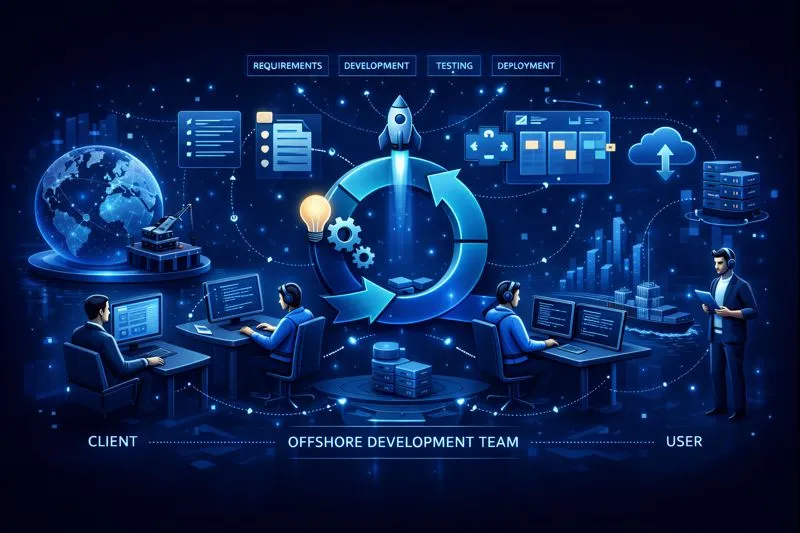
How Agile Offshore Software Development Works?
Team Structure in Agile Offshore Projects
A well-defined team structure is essential for the success of Agile offshore development. Each role carries specific responsibilities to maintain alignment, productivity, and accountability:
- Product Owner (Onshore or Client-Side): Responsible for defining the product vision, prioritizing the backlog, and ensuring that development efforts deliver real business value.
- Scrum Master / Agile Coach: Facilitates Agile ceremonies, removes obstacles, and ensures that Agile principles are consistently applied across offshore teams.
- Offshore Development Team: Typically includes software engineers, QA specialists, and DevOps professionals who work collaboratively to deliver shippable product increments each sprint.
This clear separation of roles allows offshore teams to operate autonomously while staying fully aligned with client expectations.
Agile Development Workflow Across Offshore Teams
Agile offshore projects follow an iterative workflow designed to maximize flexibility and visibility:
1. Backlog Planning and Refinement: Business requirements are translated into user stories, prioritized, and refined collaboratively by the Product Owner and offshore team.
2. Sprint Planning: The team commits to a set of tasks for a short development cycle (usually 1–2 weeks), based on capacity and priority.
3. Development and Testing: Features are designed, developed, and tested continuously within the sprint to ensure quality at every stage.
4. Sprint Review and Demo: Completed work is demonstrated to stakeholders for feedback and validation.
5. Sprint Retrospective: The team reflects on performance and identifies opportunities for continuous improvement.
This cyclical process ensures early feedback, reduced risk, and continuous delivery of value.
Agile Methodologies Commonly Used in Offshore Development
Different Agile frameworks are applied depending on project scale and complexity:
- Scrum – Ideal for most offshore software projects due to its structured ceremonies and clear roles.
- Kanban – Suitable for maintenance, support, or continuous delivery environments.
- SAFe (Scaled Agile Framework) – Used for large enterprises managing multiple offshore teams and complex product ecosystems.
These frameworks provide consistency while allowing flexibility based on business needs.
Effective communication is the backbone of Agile offshore development. Teams rely on a combination of synchronous and asynchronous practices to overcome geographical challenges:
- Daily stand-ups scheduled during overlapping working hours
- Regular sprint reviews and planning sessions
- Asynchronous updates via task boards and documentation
Commonly used tools include Jira, Confluence, Slack, GitHub, and Zoom, enabling real-time visibility into progress, blockers, and deliverables.
Key Benefits of Agile Offshore Software Development
Agile Offshore Software Development delivers far more than just cost savings. By blending Agile principles with globally distributed teams, this model creates a powerful foundation for sustainable growth, innovation, and long-term competitiveness. Below are the key benefits that make Agile offshore development a strategic choice for modern businesses:
- Faster Time-to-Market: Short, iterative development cycles allow teams to release functional software early and often. Businesses can validate ideas quickly, respond to user feedback in real time, and stay ahead of competitors in fast-moving markets.
- Cost Efficiency Without Compromising Quality: Offshore teams help reduce development and operational costs, while Agile practices ensure quality is built into every sprint through continuous testing, reviews, and improvements, resulting in better ROI, not just lower expenses.
- High Flexibility in Scope and Requirements: Agile offshore development makes it easy to adapt to changing business needs. Features can be reprioritized, refined, or replaced without disrupting the entire project, allowing organizations to remain responsive and resilient.
- Scalable Access to Global Talent: Companies can quickly scale teams up or down based on project demands while gaining access to highly skilled engineers, testers, and DevOps specialists from global talent pools.
- Improved Transparency and Predictability: Regular sprint reviews, clear task tracking, and measurable progress provide full visibility into development status, timelines, and potential risks, eliminating surprises at the end of the project.
- Stronger Collaboration Between Stakeholders and Teams: Continuous communication and shared ownership foster a true partnership between clients and offshore teams, ensuring that business objectives and technical execution stay perfectly aligned.
- Higher Product Quality and Reduced Risk: Continuous integration, frequent testing, and early feedback loops help identify issues sooner, reduce rework, and significantly lower the risk of costly late-stage failures.
Ultimately, Agile Offshore Software Development empowers organizations to build better software, faster, smarter, and more efficiently while maintaining full control over quality and direction. When executed correctly, it transforms offshore development from a cost-driven tactic into a long-term strategic advantage.
Blog Serdao:
it support services
helpdesk définition
support informatique
niveau de support
Common Use Cases of Agile Offshore Software Development
Agile Offshore Software Development is highly versatile and can be applied across a wide range of industries and project types. Thanks to its flexibility, scalability, and collaborative nature, this model adapts seamlessly to different business goals, from rapid experimentation to long-term product growth. Below are some of the most common and effective use cases:
- Startup and MVP Development: Agile offshore teams enable startups to build Minimum Viable Products quickly, validate ideas early, and iterate based on real user feedback, without heavy upfront investment or long development cycles.
- Web and Mobile Application Development: Ideal for building scalable web platforms, SaaS products, and cross-platform mobile applications, where frequent updates, UI/UX improvements, and feature enhancements are essential.
- Enterprise Software and Digital Transformation: Enterprises leverage Agile offshore development to modernize legacy systems, migrate to the cloud, adopt microservices architectures, and accelerate large-scale digital transformation initiatives.
- Long-Term Dedicated Development Teams: Companies seeking ongoing development, maintenance, and continuous improvement often use Agile offshore teams as an extension of their in-house workforce, ensuring stability and deep product knowledge over time.
- Product Scaling and Feature Expansion: When a product gains traction, Agile offshore teams help rapidly scale development efforts, add new features, and optimize performance without disrupting existing operations.
- Maintenance, Support, and Continuous Improvement: Agile offshore development is also well-suited for post-launch support, bug fixing, performance optimization, and iterative enhancements driven by user analytics and feedback.
In practice, Agile Offshore Software Development is not limited to a single scenario, it evolves alongside the business. Whether launching a new product or scaling an established platform, this approach provides the agility and global reach needed to support long-term success in a competitive digital environment.
Conclusion
Agile Offshore Software Development is no longer just a cost-saving option, it is a strategic approach to building software that aligns speed, quality, and global collaboration. By combining Agile methodologies with offshore expertise, businesses gain the flexibility to adapt to change, scale efficiently, and deliver real value faster.
Whether you are launching a new product, modernizing enterprise systems, or expanding an existing platform, Agile offshore development empowers organizations to innovate with confidence and stay competitive in an increasingly digital world.